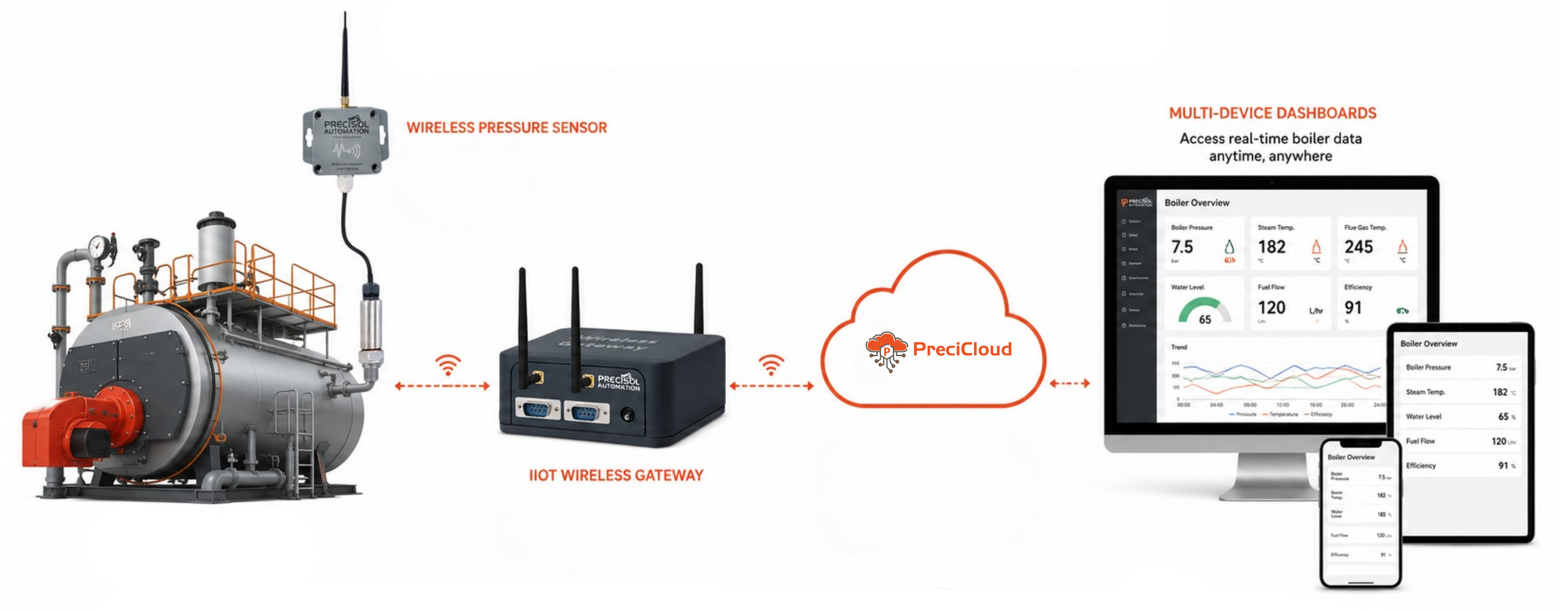
Industrial boiler monitoring with IoT sensors provides continuous, real-time visibility of the pressure, temperature, flow, and combustion parameters that determine both the safety and efficiency of steam-generating plant. Boilers are critical pressure vessels where deviations from normal operating parameters carry serious safety risks — overpressure, dry firing, flame failure, and feedwater contamination all represent hazards that boiler safety monitoring systems are designed to detect before they escalate. At the same time, industrial boiler monitoring provides the operational data needed to optimise combustion efficiency, track fuel consumption, and demonstrate regulatory compliance. A steam boiler IoT system that integrates boiler pressure monitoring, temperature sensing, and combustion analytics in a cloud platform gives operations teams the situational awareness they need to run boilers safely, efficiently, and with full audit trails — whether personnel are on-site or remote.
Critical Parameters in Industrial Boiler Monitoring
A complete industrial boiler monitoring system tracks multiple parameters simultaneously, using a combination of boiler temperature sensor inputs, pressure transmitters, flow meters, and combustion analysers:
- Steam Drum Pressure: The core measurement in boiler pressure monitoring — drum pressure must be maintained within the working pressure range. The industrial boiler monitoring system alerts when drum pressure approaches the safety valve lift pressure or drops below minimum operating pressure.
- Flue Gas and Stack Temperature: The boiler temperature sensor in the flue gas stream measures combustion product temperature. A rising stack temperature at constant load indicates heat transfer surface fouling — a key efficiency KPI tracked by the steam boiler IoT platform.
- Drum Water Level: Low water level in the steam drum is the most dangerous boiler condition — it exposes the heating surfaces and can cause catastrophic failure. Boiler safety monitoring of drum level provides continuous high/low level alarming with configurable latching logic.
- Feed Water Flow and Temperature: Industrial boiler monitoring of feed water flow rate and inlet temperature feeds the energy balance calculation for efficiency tracking and confirms that the feed pump is operating correctly.
- Flame Presence: Flame detection is a fundamental boiler safety monitoring function — loss of flame with fuel continuing to flow creates an explosion risk. The steam boiler IoT flame monitoring channel triggers immediate fuel shut-off interlock on flame failure.
Boiler Safety Monitoring: Meeting Regulatory Requirements
Industrial boiler monitoring and boiler safety monitoring are increasingly required by industrial insurance underwriters and safety regulators across sectors. Key regulatory requirements that a steam boiler IoT monitoring platform supports:
| Regulatory Area | Industrial Boiler Monitoring Requirement |
|---|---|
| Pressure Safety | Boiler pressure monitoring records demonstrating operation within design limits |
| Water Quality | Boiler temperature sensor and conductivity data for blowdown management |
| Emissions Compliance | Stack temperature and flue gas O₂ data for combustion efficiency records |
| Incident Reporting | Time-stamped boiler safety monitoring alarm logs for incident investigation |
| Operator Rounds Verification | Automated industrial boiler monitoring vs. manual round logs |
Efficiency Gains from Steam Boiler IoT Monitoring
Beyond boiler safety monitoring, industrial boiler monitoring platforms deliver measurable fuel efficiency improvements. The steam boiler IoT system tracks fuel-to-steam efficiency by correlating fuel flow, combustion air flow, steam output, and flue gas oxygen content. When combustion efficiency degrades — due to burner wear, heat exchanger fouling, or air-fuel ratio drift — the boiler pressure monitoring and boiler temperature sensor trends reveal the degradation days before it becomes visible on local instruments. Proactive adjustment of air-fuel ratio based on industrial boiler monitoring data typically improves combustion efficiency by 3–8%, with direct fuel cost savings that typically exceed the capital cost of the monitoring system within the first operating year.
Implement Industrial Boiler Monitoring with Precisol Automation
Precisol Automation's RS485 Serial IIoT Edge Gateway connects RS485 Modbus-communicating boiler instruments — pressure transmitters, temperature sensors, flow meters, and combustion analysers — to a cloud industrial boiler monitoring platform without replacing any existing field instruments. The Wireless Pressure Sensor enables rapid deployment of boiler pressure monitoring on auxiliary lines and secondary steam headers without new cable runs.
See industrial boiler monitoring in action in our industrial boiler monitoring case study, or explore how Precisol enables remote Modbus PLC monitoring as part of a complete steam boiler IoT and boiler safety monitoring solution.
Frequently Asked Questions
What parameters are measured in industrial boiler monitoring?
Industrial boiler monitoring measures steam drum pressure (boiler pressure monitoring), flue gas and stack temperature (boiler temperature sensor), drum water level, feed water flow, fuel consumption, flame presence, and flue gas oxygen content. Steam boiler IoT platforms transmit all parameters to cloud dashboards for trending, alarming, and regulatory reporting.
How does IoT improve boiler safety monitoring?
IoT enables continuous, remote boiler safety monitoring — alerting teams via SMS or email when boiler pressure monitoring detects overpressure, drum level falls critically low, or boiler temperature sensor data indicates combustion problems. Steam boiler IoT platforms provide audit-trail alarm logs required by safety regulators, ensuring industrial boiler monitoring compliance around the clock.
Can industrial boiler monitoring help reduce fuel consumption?
Yes. Industrial boiler monitoring of flue gas O₂, stack temperature (boiler temperature sensor), and steam output enables combustion optimisation. Steam boiler IoT trending identifies burner degradation and heat exchanger fouling before efficiency drops significantly. Plants implementing data-driven boiler safety monitoring and efficiency tracking typically achieve 3–8% fuel savings.