Pump condition monitoring uses IoT sensors to continuously track the health of centrifugal, positive displacement, and submersible pumps — detecting developing faults like bearing degradation, seal wear, pump cavitation, and impeller damage before they progress to failure and cause costly, unplanned downtime. Pumps are among the most critical and failure-prone assets in any industrial plant, process facility, or water utility. A failed pump stops not just its own circuit but often the entire process line it serves. Pump health monitoring with permanently installed IoT sensors converts unpredictable pump failures into manageable, scheduled maintenance events. Centrifugal pump IoT monitoring is particularly effective because centrifugal pumps exhibit clear condition signatures — changes in vibration, pressure, flow, and temperature that indicate developing faults — that can be detected and trended weeks before failure using the right sensor suite and analytics platform.
Key Failure Modes in Centrifugal Pumps and What Monitors Them
Effective pump condition monitoring requires understanding which fault modes are most likely and which sensors provide the earliest warning. For centrifugal pump IoT monitoring, the primary failure modes and their indicators are:
- Bearing Failure: The most common cause of pump failure. Pump health monitoring via pump vibration sensors detects bearing defect frequencies in the FFT spectrum weeks before catastrophic bearing collapse. Bearing temperature trending (via bearing housing temperature sensors) provides secondary confirmation.
- Mechanical Seal Failure: Seal wear causes leakage, which leads to motor damage and process contamination. Pump condition monitoring tracks seal face temperature and vibration at the seal region — a rising trend indicates increasing seal face friction and degradation.
- Pump Cavitation: Cavitation causes impeller erosion and broadband vibration. Pump cavitation detection via pump vibration sensor and suction pressure monitoring identifies NPSH margin erosion and the onset of vapour bubble formation before impeller damage accumulates.
- Impeller Wear or Damage: As the impeller wears, pump efficiency degrades — differential pressure at rated flow decreases. Centrifugal pump IoT tracking of suction-to-discharge differential pressure and flow rate reveals efficiency loss that indicates progressive impeller wear.
- Misalignment and Imbalance: Shaft misalignment causes characteristic vibration at 2× shaft speed; imbalance shows at 1× shaft speed. Both are detectable in early stages via pump health monitoring vibration analysis.
Pump Cavitation Detection: The Most Destructive and Detectable Fault
Cavitation is one of the most destructive failure modes in centrifugal pump IoT applications — it erodes impellers, damages seals, and causes rapid pump failure if sustained. Pump cavitation detection via IoT monitoring uses two complementary methods:
| Method | Measurement | Pump Cavitation Detection Indicator |
|---|---|---|
| Vibration Analysis | Pump vibration sensor on pump casing near impeller | Broadband high-frequency vibration energy increase (500 Hz–25 kHz range) |
| Suction Pressure Monitoring | Pressure transmitter on pump suction port | Suction pressure below NPSH required; pressure fluctuation at impeller pass frequency |
| Discharge Pressure Fluctuation | Pump condition monitoring of outlet pressure | Unstable discharge pressure — pulsating flow from partial cavitation |
| Performance Deviation | Centrifugal pump IoT flow vs pressure tracking | Pump operating off design curve; flow collapse with rising head indicating full cavitation |
Building a Centrifugal Pump IoT Monitoring System
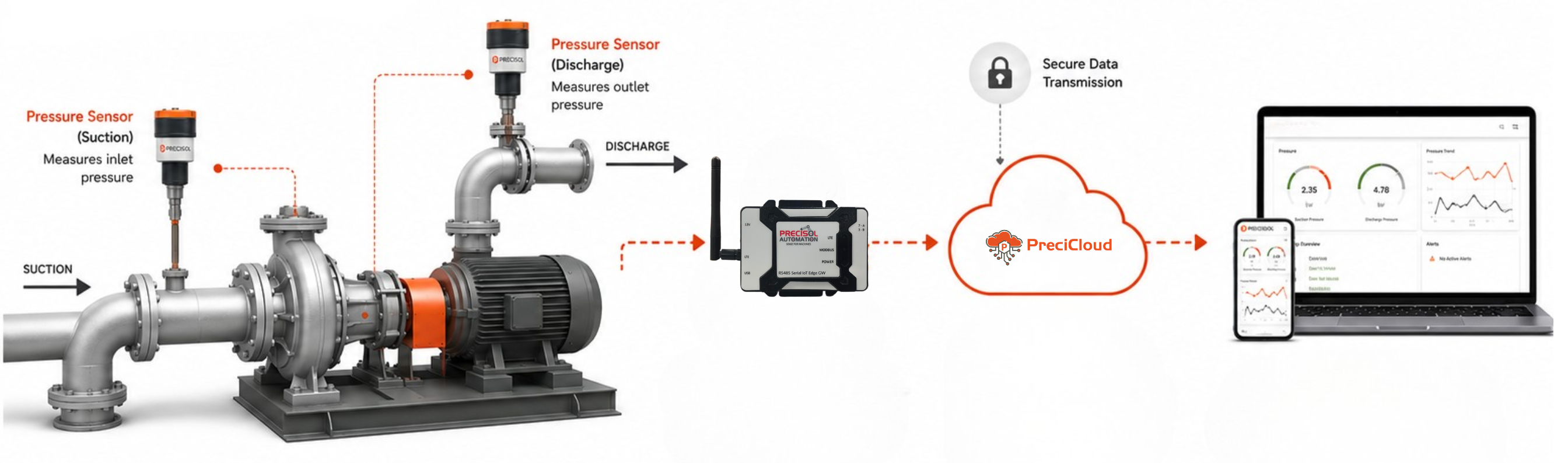
A complete pump condition monitoring system for a centrifugal pump requires: a pump vibration sensor (accelerometer) on the pump and motor bearing housings; a pressure transmitter on suction and discharge lines for pump cavitation detection and performance tracking; a temperature sensor on the bearing housing and motor winding; and an IIoT gateway to collect, process, and transmit all sensor data to the centrifugal pump IoT monitoring cloud. Alert thresholds are configured per pump — based on the pump's design operating point, baseline vibration measurements taken during commissioning, and the manufacturer's rated temperature limits. When any parameter deviates from normal by a configured threshold, the pump health monitoring platform triggers an alert with the fault type, affected parameter, and trend history.
Deploy Pump Condition Monitoring with Precisol Automation
Precisol Automation's Wireless Pressure Sensor installs on pump suction and discharge ports without wiring — transmitting pressure data wirelessly for pump condition monitoring and pump cavitation detection via cloud analytics. The RS485 Serial IIoT Edge Gateway integrates wired vibration, pressure, and temperature transmitters into a unified centrifugal pump IoT monitoring stream with edge threshold alerting.
See pump health monitoring preventing unplanned pump failures in our pump health monitoring case study, or explore how Precisol supports smart flow meter monitoring as part of a complete pump condition monitoring solution.
Frequently Asked Questions
What sensors are used for pump condition monitoring?
Pump condition monitoring uses pump vibration sensors on bearing housings, pressure transmitters on suction/discharge ports (for pump cavitation detection), temperature sensors on casing and motor, and flow meters for efficiency tracking. Centrifugal pump IoT platforms combine all these signals for comprehensive pump health monitoring.
How does pump cavitation detection work with IoT sensors?
Pump cavitation detection monitors broadband high-frequency vibration (via pump vibration sensor) and suction pressure. Cavitation generates characteristic wideband vibration from bubble collapse and causes suction pressure instability. Centrifugal pump IoT platforms combine both signals to detect cavitation onset before sustained impeller erosion occurs.
What pump faults can condition monitoring detect early?
Pump condition monitoring detects bearing degradation, seal wear, pump cavitation, impeller wear, misalignment, and dry running — all via sensor signatures detectable weeks before failure. Centrifugal pump IoT monitoring of vibration, pressure, temperature, and flow gives a complete pump health monitoring picture for proactive maintenance planning.