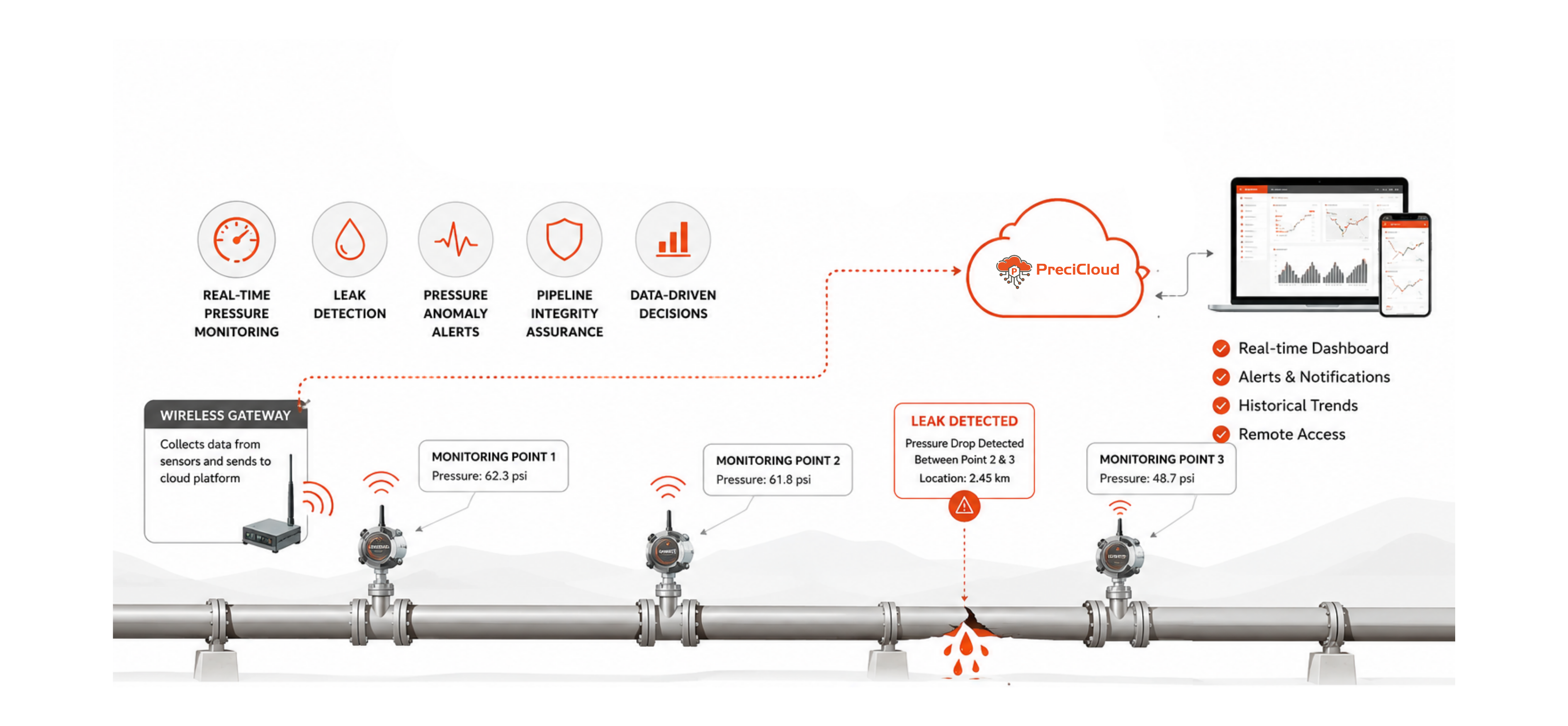
Pipeline integrity monitoring with wireless pressure sensors enables real-time visibility of pressure conditions at multiple points along liquid and gas distribution networks — detecting leaks, pressure anomalies, and developing integrity threats before they escalate to environmental incidents, production losses, or safety events. Traditional industrial pressure monitoring of pipelines relied on periodic manual inspections or fixed wired pressure gauges at accessible locations. The deployment of wireless pressure sensor networks transforms this into a continuous, automated pipeline integrity monitoring system that covers the full pipeline length — including remote sections where manual inspection is infrequent and wiring is impractical. Pipeline leak detection using pressure differential analysis and negative pressure wave techniques gives operations teams early, automated warning of integrity events, enabling rapid response that minimises product loss, environmental impact, and regulatory liability.
What Pipeline Integrity Monitoring Detects
A pipeline IoT solution based on continuous wireless pressure sensor data monitors for multiple integrity threat types simultaneously:
- Active Leaks: The primary function of most pipeline integrity monitoring deployments — pipeline leak detection via abnormal pressure drop between adjacent wireless pressure sensor nodes, or via negative pressure wave analysis for large leaks.
- Pressure Exceedances: Industrial pressure monitoring ensures pipeline pressure stays within design MAOP (Maximum Allowable Operating Pressure). Exceedances can cause stress corrosion cracking acceleration and fitting failure.
- Blockages: A blocked pipeline segment shows abnormal pressure build-up upstream and pressure drop downstream — detectable by the pipeline integrity monitoring differential pressure pattern across the blockage location.
- Surge Events: Water hammer and hydraulic transient events generate high-frequency pressure spikes that can fracture fittings and weaken pipe walls. Pipeline IoT solution monitoring at high sample rates captures surge events that conventional slow-scan pressure indicators miss.
- Long-Term Pressure Trends: Gradual pressure reduction at constant flow rate indicates progressive restriction — corrosion buildup, scale deposition, or external soil movement on the pipe — detectable through pipeline integrity monitoring long-term trending.
Wireless Pressure Sensor Networks for Pipeline Monitoring
A wireless pressure sensor network for pipeline integrity monitoring consists of sensor nodes installed at key monitoring points along the pipeline, transmitting data wirelessly to a gateway that forwards it to a cloud pipeline IoT solution platform. The benefits of a wireless pressure sensor approach over traditional wired industrial pressure monitoring:
| Factor | Wired Industrial Pressure Monitoring | Wireless Pressure Sensor Pipeline IoT Solution |
|---|---|---|
| Installation Cost | High — cable trenching along pipeline route | Low — wireless pressure sensor clips to existing pressure port |
| Monitoring Point Density | Limited by cable cost — few points | High — many wireless pressure sensor nodes economical |
| Remote Locations | Impractical without power and comms infrastructure | Battery-powered wireless pressure sensor with cellular gateway |
| Pipeline Leak Detection Resolution | Limited by sparse monitoring points | Higher with dense wireless pressure sensor spacing |
| Data Access | Local only (SCADA) | Cloud dashboard — remote pipeline integrity monitoring from anywhere |
Deploying a Pipeline IoT Solution: Key Considerations
Effective pipeline integrity monitoring requires careful placement of wireless pressure sensor nodes and configuration of the pipeline leak detection analytics. Node spacing should reflect the pipeline leak detection resolution required — closer spacing improves leak location accuracy. For industrial pressure monitoring of high-consequence liquid pipelines, nodes every 500 m to 2 km are typical. Wireless pressure sensor battery life at the chosen transmission interval must be verified — many deployments require 2–5 year battery life without site access. The gateway powering the pipeline IoT solution must be located within radio range of all sensor nodes, or a mesh or cellular-connected gateway deployed at each section of the pipeline for extended-length pipeline integrity monitoring.
Implement Pipeline Integrity Monitoring with Precisol Automation
Precisol Automation's Wireless Pressure Sensor installs directly on pipeline pressure ports without cable runs — providing continuous industrial pressure monitoring data for pipeline integrity monitoring and pipeline leak detection applications. The Wireless Gateway aggregates data from multiple wireless pressure sensor nodes across the pipeline and forwards it to a cloud pipeline IoT solution platform for real-time alerting and historical trending.
See wireless pressure sensor deployment enabling automated pipeline integrity monitoring in our industrial pipeline monitoring case study, or explore how Precisol supports wireless pressure sensor for greenhouse irrigation monitoring — another pipeline IoT solution application.
Frequently Asked Questions
How does wireless pressure sensor monitoring detect pipeline leaks?
Pipeline leak detection uses wireless pressure sensor data from multiple points along the pipeline. A leak causes a localised pressure drop detectable by comparing adjacent node readings. Advanced pipeline IoT solutions use negative pressure wave analysis — the pressure transient from a leak propagates to two wireless pressure sensor locations, and the arrival time difference locates the leak precisely.
What makes wireless pressure sensors better than wired for pipeline integrity monitoring?
Wireless pressure sensors eliminate cable trenching — the dominant cost of traditional industrial pressure monitoring along pipeline routes. They enable dense monitoring point spacing and coverage of remote pipeline sections. Battery-powered wireless pressure sensor nodes require no power infrastructure, making pipeline integrity monitoring practical for long-distance and cross-country pipelines.
How often should pipeline integrity monitoring data be transmitted?
For pipeline leak detection, wireless pressure sensors should transmit at 1–5 minute intervals minimum. For negative pressure wave analysis, 10–100 Hz sampling is needed. General pipeline integrity monitoring of pressure trends and industrial pressure monitoring compliance can use 15-minute or hourly intervals — configure based on fluid type, regulatory requirements, and leak consequence severity.