Industrial IoT Gateway Buying Guide: 10 Features to Evaluate
15 July 2026
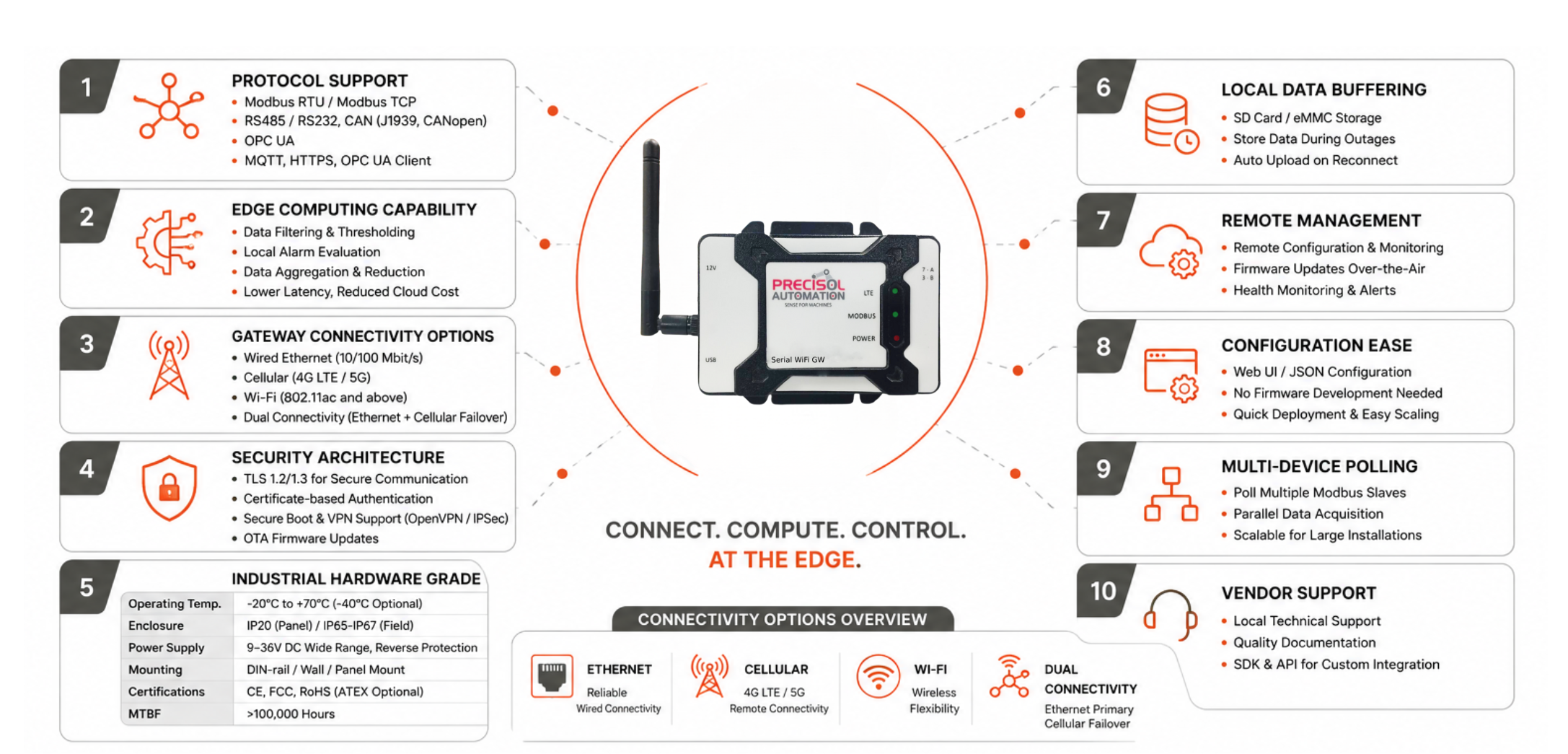
Selecting the right industrial IoT gateway is one of the most consequential infrastructure decisions in any IIoT project. The industrial IoT gateway sits at the boundary between your operational technology (OT) field devices and the IT world — translating protocols, processing data at the edge, and securely forwarding machine intelligence to cloud platforms. Poor IIoT gateway selection leads to integration headaches, security vulnerabilities, and devices that can't scale with your data strategy. This buying guide covers the 10 most critical edge gateway features to evaluate, helping you make a rigorous industrial hardware selection decision that serves your plant for years.
1. Protocol Support: The Core of IIoT Gateway Selection
An industrial IoT gateway is only as useful as the protocols it supports on the field side. The most important edge gateway features for protocol coverage include Modbus RTU and Modbus TCP, RS485 and RS232 serial, CAN bus (J1939 and CANopen), and OPC UA. If your plant uses specialised PLCs running Profinet or EtherNet/IP, verify native support before committing to any industrial IoT gateway. On the cloud side, the industrial IoT gateway should support MQTT (with configurable QoS and TLS), HTTPS REST API, and optionally OPC UA client for IT system integration.
2. Edge Computing Capability
A smart industrial IoT gateway does more than pass data through — it processes it locally. Key edge gateway features to look for in this area: configurable data filtering (only send values when they change beyond a threshold), local alarm evaluation (trigger an output or notification when a sensor exceeds a limit without waiting for a cloud round-trip), and data aggregation (calculate min/max/average over a time window before transmission). Edge computing capability in the industrial IoT gateway reduces cloud data costs, lowers latency for local actions, and maintains functionality when cloud connectivity is temporarily lost.
3. Gateway Connectivity Options
Gateway connectivity determines how the industrial IoT gateway reaches the internet or corporate network. Evaluate these gateway connectivity options during IIoT gateway selection:
- Wired Ethernet: The most reliable gateway connectivity for plant-installed industrial IoT gateways. Look for 10/100 Mbit/s support and static IP configuration.
- Cellular (4G LTE / 5G): Essential gateway connectivity for remote sites, mobile assets, and backup connectivity. Evaluate SIM flexibility (multi-operator support) and VPN capability.
- Wi-Fi: Useful gateway connectivity where Ethernet is impractical. Verify 802.11ac (Wi-Fi 5) or newer and WPA2/WPA3 enterprise support for industrial environments.
- Dual Connectivity: Premium industrial IoT gateways support Ethernet-primary with cellular failover — the most resilient gateway connectivity architecture for critical monitoring applications.
4. Security Architecture
IIoT gateway selection must include rigorous security evaluation. Edge gateway features to check: TLS 1.2/1.3 for all cloud transmissions, certificate-based device authentication (not just password-based), secure boot to prevent firmware tampering, and VPN client support (OpenVPN or IPSec) for private network connectivity. An industrial IoT gateway with weak security is an OT network vulnerability — verify that the industrial hardware selection includes security update capability (OTA firmware updates) so the gateway can receive patches throughout its field lifetime.
5. Industrial Hardware Selection Grade
Industrial hardware selection criteria go beyond datasheet specifications. The industrial IoT gateway must survive the real environment it will be installed in:
| Specification | What to Look For in Industrial Hardware Selection |
|---|---|
| Operating Temperature | -20°C to +70°C minimum; -40°C for outdoor or cold-climate deployments |
| Enclosure Protection | IP20 for panel mounting; IP65/IP67 for field installation |
| Power Supply | Wide-range DC input (9–36V) for panel compatibility; reverse polarity protection |
| Mounting | DIN-rail for control panels; wall/panel mount options for flexibility |
| Certifications | CE, FCC, RoHS as minimum; ATEX for hazardous area industrial hardware selection |
| MTBF | >100,000 hours for mission-critical industrial IoT gateway deployments |
6–10: Additional Edge Gateway Features to Evaluate
Beyond the core criteria, complete IIoT gateway selection should consider: local data buffering (SD card or eMMC to store data during connectivity outages and upload when reconnected); remote management (cloud-based configuration, firmware update, and health monitoring without site visits); configuration ease (web UI or JSON configuration without firmware development); multi-device polling (ability to poll many Modbus slaves simultaneously, not just one at a time); and vendor support (local technical support, documentation quality, and SDK availability for custom edge gateway features). An industrial IoT gateway from a vendor with poor documentation and no local support will cost far more in integration time than any upfront price savings.
Find the Right Industrial IoT Gateway with Precisol Automation
Precisol Automation designs industrial IoT gateways specifically for the demands of plant-floor deployment — wide-temperature operation, multi-protocol support, and edge computing capability that requires no firmware development. The Serial IIoT Gateway covers all core IIoT gateway selection criteria: RS485/RS232 serial input, Modbus RTU polling, MQTT and REST API cloud connectivity, and local edge filtering on a DIN-rail form factor. For more demanding RS485 deployments with edge analytics, the RS485 Serial IIoT Edge Gateway adds additional edge gateway features including threshold alerting and local data buffering.
See industrial IoT gateway deployment in a real boiler monitoring installation in our boiler monitoring case study, or explore how Precisol enables smart flow meter monitoring with purpose-built industrial IoT gateway hardware.
Frequently Asked Questions
What is an industrial IoT gateway?
An industrial IoT gateway connects field devices to IT networks and cloud platforms by performing protocol translation, data aggregation, and edge computing. It is the central piece of infrastructure in IIoT gateway selection — determining how efficiently, securely, and reliably your plant data reaches cloud analytics systems.
What edge gateway features are most important for industrial deployments?
The most important edge gateway features are multi-protocol support, local edge computing, secure MQTT cloud connectivity, industrial hardware selection grade (wide temperature, DIN-rail), and flexible gateway connectivity options (Ethernet, cellular, Wi-Fi). Ease of configuration without firmware development is equally critical for practical IIoT gateway selection.
How do I choose between Ethernet and cellular gateway connectivity?
Choose Ethernet gateway connectivity for plant-installed industrial IoT gateways with existing network infrastructure — it is reliable and low-latency. Choose cellular for remote sites or mobile assets. Dual gateway connectivity (Ethernet primary, cellular backup) is the most resilient industrial hardware selection for critical applications.