RS232 Cellular Gateway: Enabling Remote Monitoring Over 4G LTE
14 July 2026
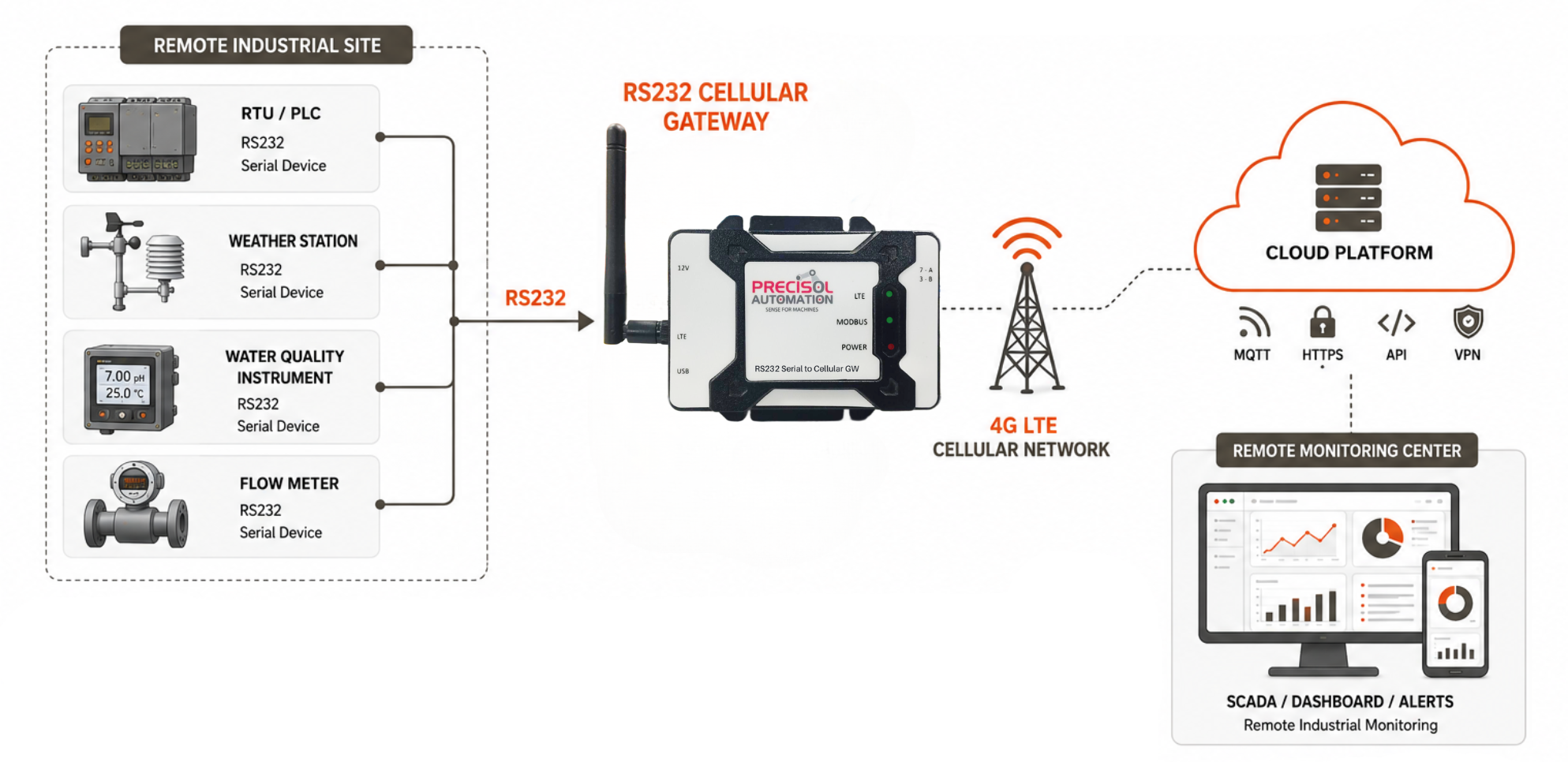
An RS232 cellular gateway is a compact device that combines an RS232 serial port with a built-in cellular modem — typically 4G LTE — to provide internet connectivity for industrial devices that have no Ethernet or Wi-Fi capability. For the thousands of water treatment plants, pumping stations, power substations, and pipeline RTUs equipped with RS232-serial instruments and PLCs, an RS232 cellular gateway is the most practical path to 4G LTE remote monitoring. No new wiring, no local network infrastructure — just plug the serial cellular modem into the existing RS232 port, insert a SIM card, and the asset is online for remote industrial monitoring via the cellular network. This guide covers how an RS232 cellular gateway works, the protocols it supports, and the security considerations for production 4G LTE remote monitoring deployments.
Why RS232 Cellular Gateway Deployments Are Growing
A significant proportion of deployed industrial infrastructure still communicates over RS232. Legacy RTUs, weather stations, water quality instruments, energy meters, and dataloggers use RS232 as their only external interface. Replacing this equipment is expensive and often unnecessary — the mechanical and measurement functions are perfectly serviceable. What these assets lack is connectivity. An RS232 cellular gateway provides that connectivity without any changes to the field device — the serial cellular modem communicates in the same RS232 protocol the device has always used, while adding 4G LTE remote monitoring capability that modern operations centres demand for remote industrial monitoring across distributed sites.
As 2G and 3G networks are decommissioned, older serial cellular modem devices running on those networks need upgrading. A 4G LTE RS232 cellular gateway replacement provides not just network continuity but dramatically improved remote industrial monitoring bandwidth — 4G LTE remote monitoring data rates are 100× faster than 2G GPRS, enabling higher reporting frequencies and binary data formats that were previously impractical.
How an RS232 Cellular Gateway Works
The RS232 cellular gateway operates as an intelligent bridge between the field device's RS232 port and the 4G LTE cellular network:
- Serial Data Collection: The RS232 cellular gateway connects to the field device's RS232 DB9 connector and communicates in the device's native protocol — Modbus RTU, ASCII, DNP3, or a proprietary format. The serial cellular modem side of the gateway polls the device at a configured interval or listens for unsolicited reports.
- Data Processing: An intelligent RS232 cellular gateway parses the serial data, extracts the relevant values (readings, alarms, status), and formats them for the cloud. This LTE IoT gateway processing step converts raw bytes into structured JSON, CSV, or protocol-specific payloads suitable for remote industrial monitoring platforms.
- 4G LTE Transmission: The processed data is transmitted via the built-in cellular modem over the 4G LTE network. The RS232 cellular gateway can publish to an MQTT broker, POST to a REST API, or connect via VPN to a private SCADA server — making 4G LTE remote monitoring possible from any location with cellular coverage.
RS232 Cellular Gateway vs Serial Cellular Modem
| Feature | Serial Cellular Modem | RS232 Cellular Gateway (LTE IoT Gateway) |
|---|---|---|
| Protocol Intelligence | None — raw byte tunnel only | Modbus RTU, DNP3, ASCII parsing |
| Cloud Connectivity | TCP socket only | MQTT, REST API, HTTPS |
| Local Processing | None | Threshold alerting, data aggregation |
| Configuration | AT commands | Web UI / JSON configuration file |
| 4G LTE Remote Monitoring | Requires server-side parsing | Structured data to cloud directly |
| Security | Basic (no VPN built in) | VPN, TLS, certificate-based MQTT |
Security for 4G LTE Remote Monitoring
Remote industrial monitoring over cellular exposes the field device to the internet — a security boundary that must be carefully managed. Production RS232 cellular gateway deployments should implement: VPN tunnelling (OpenVPN or IPSec) to encrypt the data channel between the LTE IoT gateway and the control centre; APN restriction to limit the SIM to authorised network segments; certificate-based MQTT authentication to prevent unauthorised cloud connections; and firewall rules on the RS232 cellular gateway to block all inbound connections from unknown addresses. An RS232 cellular gateway with these security features provides 4G LTE remote monitoring that meets the cybersecurity requirements increasingly mandated in water, energy, and critical infrastructure sectors.
Deploy 4G LTE Remote Monitoring with Precisol Automation
Precisol Automation's RS232 Serial to Cellular Gateway provides complete LTE IoT gateway functionality for RS232-equipped industrial devices — Modbus RTU polling, MQTT publishing, VPN support, and wide-temperature operation for harsh-environment remote industrial monitoring deployments. For RS422 and higher-speed serial applications requiring 4G LTE remote monitoring, the RS422 Serial to LTE Gateway delivers the same connectivity for longer-distance serial interfaces.
See 4G LTE remote monitoring transforming utility operations in our water treatment plant remote monitoring case study, or explore how Precisol enables building HVAC monitoring via RS232 cellular gateway connectivity.
Frequently Asked Questions
What is an RS232 cellular gateway used for?
An RS232 cellular gateway connects RS232 industrial devices to the internet via 4G LTE, enabling remote industrial monitoring without local network infrastructure. It acts as an intelligent LTE IoT gateway for water plants, substations, pipeline RTUs, and other remote assets where wired 4G LTE remote monitoring connectivity is impractical.
How is an RS232 cellular gateway different from a serial cellular modem?
A serial cellular modem provides only raw byte tunnelling. An RS232 cellular gateway is an intelligent LTE IoT gateway that understands Modbus and other protocols, formats data as MQTT or JSON payloads, and provides VPN-secured 4G LTE remote monitoring — far beyond what a basic serial cellular modem offers.
What security considerations apply to 4G LTE remote monitoring?
Secure 4G LTE remote monitoring via an RS232 cellular gateway requires VPN tunnelling, APN restriction, certificate-based MQTT authentication, and inbound firewall rules. These measures protect remote industrial monitoring deployments from internet-exposed attack surfaces inherent to LTE IoT gateway connectivity.