Protocol Conversion in Industrial Automation: Bridging Modbus, CAN, and OPC UA
16 July 2026
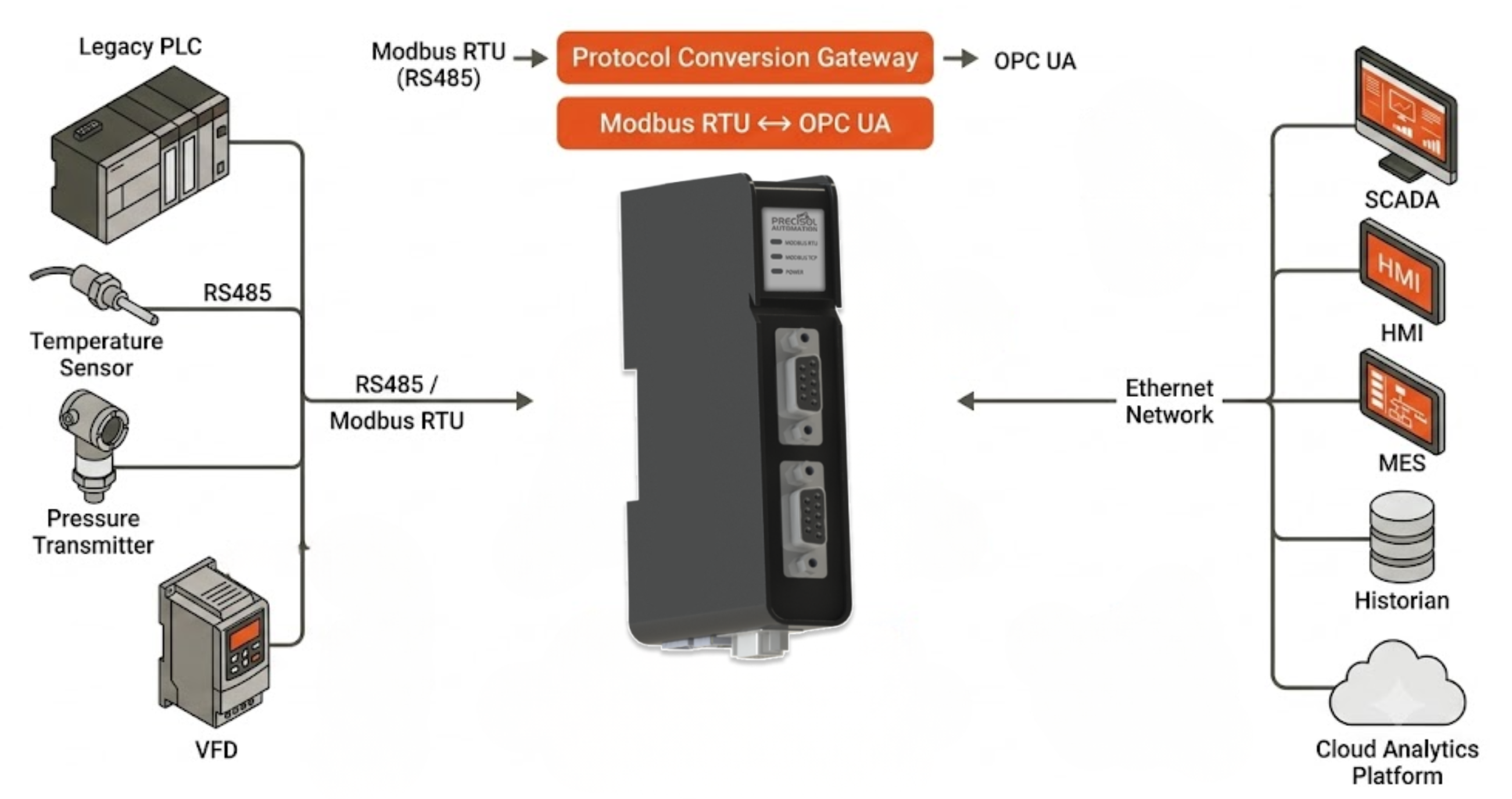
Protocol conversion in industrial automation is the process of translating communication data between incompatible protocols — enabling Modbus RTU devices to speak to OPC UA systems, CAN bus controllers to send data via MQTT, and RS485 instruments to feed Ethernet-based cloud platforms. A protocol converter is the hardware device that performs this translation, making legacy PLC integration possible without replacing functional equipment. The need for protocol conversion industrial automation solutions has grown sharply as plants modernise their IT infrastructure while continuing to operate OT equipment that communicates over proprietary or decades-old serial protocols. A well-chosen protocol converter resolves this heterogeneity — the central challenge in any legacy PLC integration project — without the capital expense of wholesale equipment replacement.
Why Protocol Conversion in Industrial Automation Is Essential
Industrial automation has never been served by a single, universal communication standard. At the field level, Modbus RTU over RS485 has dominated serial device communication for forty years. CAN bus and J1939 are dominant in vehicle and mobile equipment control. At the supervisory level, OPC UA has become the Industry 4.0 standard. At the cloud level, MQTT and REST APIs are universal. These layers were designed independently and are incompatible by nature. Protocol conversion industrial automation gateways bridge these layers, enabling data to flow from a Modbus PLC through a protocol converter to an OPC UA SCADA system and onward to a cloud analytics platform — without any modification to the original PLC, its programme, or its physical wiring.
Legacy PLC integration via protocol conversion is far more cost-effective than hardware replacement. A Modbus RTU PLC installed in 2010 may have a 25-year service life — replacing it simply to gain OPC UA connectivity throws away years of remaining value. A protocol converter adds the missing interface for a fraction of the replacement cost, preserving the existing legacy PLC integration investment while enabling modern Modbus to OPC UA connectivity.
Common Protocol Conversion Industrial Automation Scenarios
- Modbus to OPC UA: The most common protocol conversion industrial automation scenario — a Modbus RTU or TCP protocol converter maps PLC registers to OPC UA nodes, making them accessible to any OPC UA client (SCADA, MES, historian, cloud gateway). Modbus to OPC UA conversion is foundational to Industry 4.0 migrations using existing PLC infrastructure.
- Modbus RTU to Modbus TCP: A protocol converter bridges RS485 serial Modbus devices to Ethernet, enabling legacy PLC integration with Ethernet-only SCADA systems without replacing serial instruments. This is the simplest form of protocol conversion industrial automation.
- CAN Bus to MQTT: A protocol converter reads J1939 or CANopen data from CAN bus controllers and publishes it as MQTT payloads to a cloud broker. This protocol conversion industrial automation scenario is common in fleet telematics and mobile equipment monitoring.
- RS485 to REST API: A protocol converter polls RS485 Modbus slaves and exposes their data as a REST API endpoint, enabling web application legacy PLC integration without custom middleware development.
- Modbus to MQTT: Increasingly common protocol conversion industrial automation for IIoT applications — the protocol converter polls Modbus registers and publishes selected values to an MQTT broker, enabling cloud-direct machine monitoring from legacy field devices.
How a Protocol Converter Works
A hardware protocol converter for industrial automation typically operates in three functional stages. First, the acquisition stage: the protocol converter communicates with the source device in its native protocol — polling Modbus RTU registers over RS485, reading CAN bus messages, or receiving RS232 serial frames. Second, the mapping stage: the protocol conversion industrial automation engine translates the acquired data into the target protocol's data model — mapping Modbus register values to OPC UA node variables for Modbus to OPC UA conversion, or formatting CAN bus signal values into JSON for MQTT publishing. Third, the publication stage: the protocol converter exposes the translated data to the target system — as an OPC UA server, MQTT publisher, REST API, or Modbus TCP server.
Intelligent protocol converters also apply engineering unit scaling (converting raw register values to physical units like bar, °C, or m³/h), alarm evaluation (triggering alerts when translated values exceed thresholds), and data buffering (caching translated values during connectivity outages for later forwarding) — adding value beyond basic legacy PLC integration to full edge intelligence.
Selecting the Right Protocol Converter
| Requirement | Protocol Converter Selection Criteria |
|---|---|
| Source Protocol | Modbus RTU, Modbus TCP, CAN J1939, CANopen, RS232/RS485 raw serial |
| Target Protocol | OPC UA, MQTT, REST API, Modbus TCP — verify Modbus to OPC UA mapping depth |
| Legacy PLC Integration Depth | Number of Modbus slaves polled, registers per slave, CAN bus IDs parsed |
| Configuration Method | Web UI or JSON file — avoid protocol converters that require firmware programming |
| Industrial Grade | Wide temperature, DIN-rail, wide-voltage DC input for panel installation |
| Security | TLS encryption, certificate auth for Modbus to OPC UA and MQTT connections |
Precisol Automation: Purpose-Built Protocol Converters for Industrial Automation
Precisol Automation's Modbus RTU to TCP Converter is a dedicated protocol conversion industrial automation device that bridges RS485 Modbus RTU field devices to Ethernet Modbus TCP networks — the first and most essential step in legacy PLC integration for Ethernet-based SCADA systems. For CAN bus and multi-protocol legacy PLC integration scenarios, the CAN Bus Gateway performs protocol conversion industrial automation across CAN, J1939, Modbus, and MQTT — enabling a single gateway to bridge diverse OT protocols to IT and cloud systems.
See protocol conversion industrial automation enabling complete IT-OT connectivity in our IT-OT bridge for process automation case study, or explore how Precisol enables remote Modbus PLC monitoring via protocol converter cloud integration.
Frequently Asked Questions
What is protocol conversion in industrial automation?
Protocol conversion in industrial automation translates data between incompatible communication protocols — such as Modbus RTU to OPC UA or CAN bus to MQTT. A protocol converter enables legacy PLC integration with modern SCADA, cloud platforms, and IT systems without replacing existing field equipment.
What protocols does a Modbus to OPC UA converter support?
A Modbus to OPC UA protocol converter reads Modbus RTU or TCP registers and maps them to OPC UA server nodes. Protocol conversion industrial automation gateways support configurable address mapping, engineering unit scaling, and bidirectional write capability for full legacy PLC integration with OPC UA SCADA systems.
When is a protocol converter needed for legacy PLC integration?
A protocol converter is needed for legacy PLC integration whenever existing equipment uses a protocol incompatible with modern systems — Modbus RTU PLCs connecting to OPC UA SCADA, RS485 instruments feeding cloud dashboards, or CAN bus controllers requiring MQTT telematics. Protocol conversion industrial automation gateways eliminate replacement costs for functional PLCs.