IT-OT Convergence: Bridging Operational and Information Technology in Industry 4.0
26 August 2026
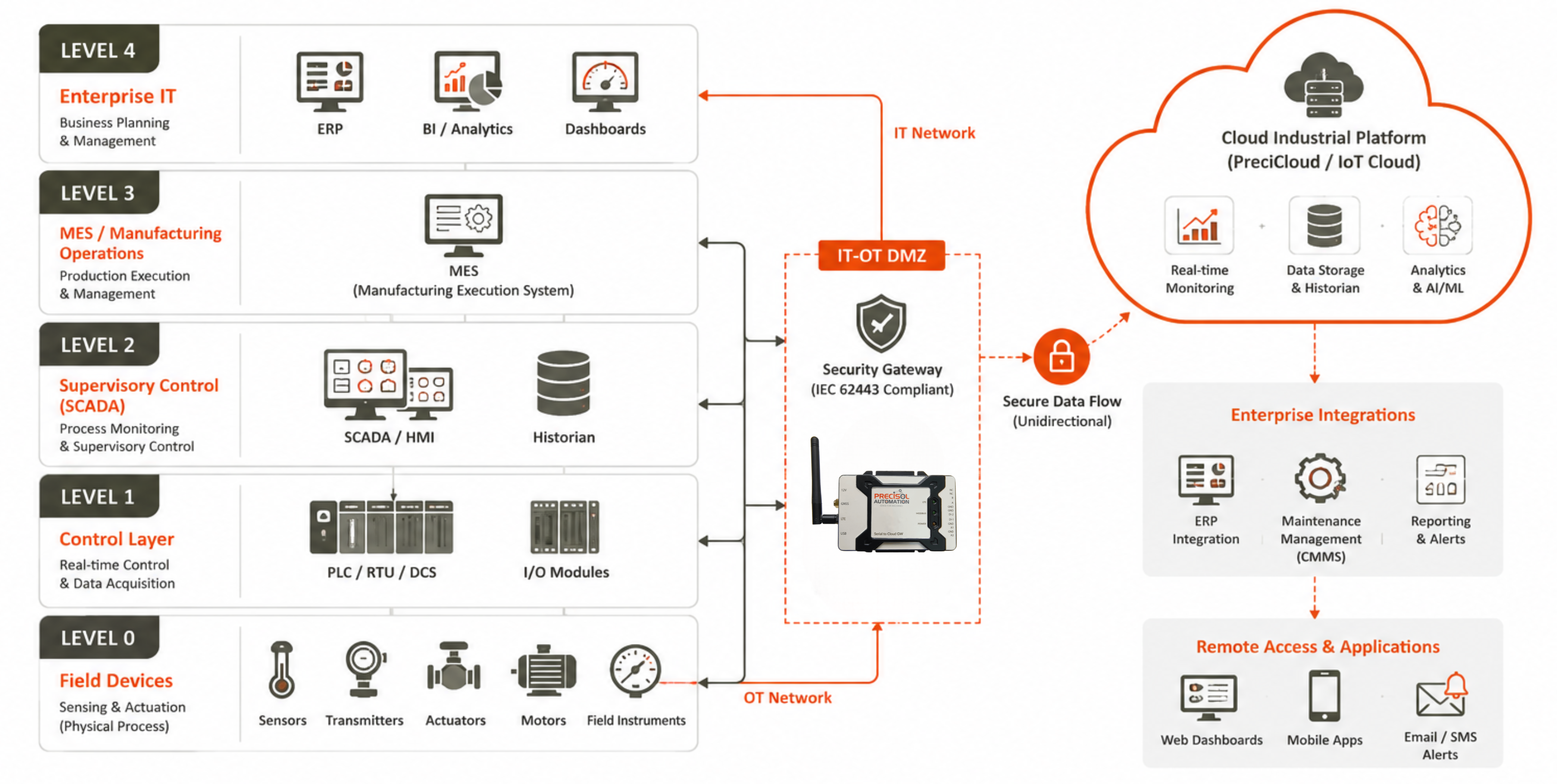
IT-OT convergence — the integration of Information Technology systems with Operational Technology networks — is the foundational enabler of Industry 4.0 manufacturing, connecting the real-time data generated by production machines, sensors, and PLCs with the enterprise analytics, ERP, and cloud platforms where that data creates business value. For decades, OT systems (PLCs, SCADA, DCS, and field devices) operated in isolated networks, physically and logically separated from IT infrastructure for safety and reliability reasons. OT network integration breaks down this separation — enabling industrial data integration that flows production data from factory floor to enterprise dashboards, and enabling enterprise decisions (production schedules, quality parameters, maintenance plans) to flow back to operational systems. Successful IT-OT convergence requires protocol bridging (translating OT protocols like Modbus and OPC UA to IT-compatible formats), security architecture (protecting OT from IT-side cybersecurity threats), and SCADA cloud integration that delivers real-time production visibility to management and analytics teams. The result is digital factory connectivity — a plant where every machine's data is visible, every process is measurable, and every operational decision can be informed by real-time production intelligence.
The IT-OT Gap: Why Convergence Is Technically Complex
IT-OT convergence is challenging because IT and OT systems were designed with fundamentally different priorities. OT systems prioritise availability and deterministic real-time response — a PLC controlling a safety system cannot be rebooted for a software update mid-production. IT systems are designed for regular patching, flexible connectivity, and interoperability with standard internet protocols. OT network integration must bridge these priorities without compromising either. Key technical challenges in industrial data integration:
- Protocol Translation: OT devices communicate over industrial protocols — Modbus RTU (serial RS485), Modbus TCP, Profibus, HART, CAN bus, DNP3, and proprietary fieldbus systems — that enterprise IT infrastructure cannot natively consume. IT-OT convergence requires industrial data integration gateways that translate these OT protocols to IT-compatible formats: OPC UA (the preferred industrial data integration standard), MQTT, REST API, or direct database connectors.
- Security Architecture: OT network integration introduces new cybersecurity attack surfaces. Industrial control system cybersecurity architecture (IEC 62443) defines a hierarchical DMZ approach — a demilitarised zone separating OT from IT, with strictly controlled, audited data flows. SCADA cloud integration typically uses a unidirectional security gateway (data diode) or an OPC UA server in the DMZ to prevent any inbound path from IT to OT.
- Legacy Equipment: Most production facilities have 10–30 year old OT assets with no native Ethernet connectivity. IT-OT convergence for legacy equipment requires serial-to-Ethernet gateways, protocol converters, and intelligent edge devices that can read older fieldbus protocols and convert to modern formats for industrial data integration.
- Data Contextualisation: Raw OT data (Register 40001 = 1234) is meaningless without context (Register 40001 = Boiler 3 steam pressure, 12.34 bar). Digital factory connectivity requires data models that add semantic context — equipment hierarchy, unit of measure, quality flag — before OT data enters IT analytics systems.
IT-OT Convergence Architecture: The Purdue Model and Beyond
| Architecture Level | IT-OT Convergence Zone | Industrial Data Integration Function |
|---|---|---|
| Level 0–1: Field Devices and Control | OT — PLCs, sensors, actuators | Real-time control; data source for OT network integration |
| Level 2: Supervisory Control (SCADA) | OT — SCADA, DCS, historian | Process visualisation; SCADA cloud integration origin point |
| Level 3: MES / Manufacturing Operations | OT/IT boundary — manufacturing execution system | Production scheduling; quality management; IT-OT convergence bridge |
| Level 4: Enterprise IT | IT — ERP, cloud analytics, business intelligence | Business KPIs from industrial data integration; digital factory connectivity |
| Cloud / Edge | IT-OT convergence cloud layer | Advanced analytics, AI, SCADA cloud integration, remote monitoring |
SCADA Cloud Integration and Digital Factory Connectivity
SCADA cloud integration is the most common starting point for IT-OT convergence — making SCADA process data available to cloud analytics, management dashboards, and enterprise reporting without replacing existing OT infrastructure. An industrial data integration gateway in the network DMZ collects OPC UA or Modbus data from the SCADA historian and publishes it to a cloud IoT platform via MQTT or REST, enabling digital factory connectivity at enterprise level. OT network integration via SCADA cloud integration typically begins with non-critical production KPIs (OEE, downtime, batch completion) to prove value and build confidence before extending to more sensitive production control data. The pattern of IT-OT convergence that most manufacturers follow: start with historian data → add real-time dashboards → connect MES → integrate ERP → enable AI/ML analytics on the combined dataset.
Deploy IT-OT Convergence with Precisol Automation
Precisol Automation's Serial IIoT Gateway bridges legacy OT serial protocols (Modbus RTU, RS485 fieldbus) to modern IT networks — enabling OT network integration for equipment without native Ethernet connectivity. The PreciCloud IoT Cloud Dashboard provides the SCADA cloud integration and digital factory connectivity layer — aggregating industrial data integration from field devices, gateways, and sensors into a unified enterprise production visibility platform.
See IT-OT convergence enabling real-time production monitoring in our IT-OT bridge for process automation case study, or explore how Precisol enables remote monitoring and control for Modbus PLCs as a practical first step in OT network integration.
Frequently Asked Questions
What is IT-OT convergence and why does it matter for Industry 4.0?
IT-OT convergence integrates Operational Technology (PLCs, SCADA, field devices) with Information Technology (ERP, cloud, analytics) — enabling industrial data integration that flows production data to enterprise systems. OT network integration makes Industry 4.0 capabilities possible: real-time production visibility, predictive maintenance, and digital factory connectivity that manufactures need to optimise operations and compete.
What are the main challenges in OT network integration with IT systems?
OT network integration challenges include protocol incompatibility (Modbus, Profibus, CAN require industrial data integration gateways for IT translation), cybersecurity risks from connecting historically isolated OT networks, real-time determinism requirements, legacy equipment without Ethernet connectivity, and IT/OT organisational culture differences. IT-OT convergence architecture using DMZ security zones and SCADA cloud integration gateways addresses these challenges.
How does SCADA cloud integration work in an IT-OT convergence architecture?
SCADA cloud integration uses an industrial data integration gateway in a DMZ to collect OPC UA or Modbus data from the SCADA system and publish it to a cloud platform via MQTT or REST. OT network integration architecture enforces unidirectional data flow (OT to IT only) via security gateways. Digital factory connectivity is achieved when cloud analytics combine SCADA data with ERP and IoT sensor data for enterprise production intelligence.