LIN Bus Protocol: A Complete Guide for Automotive Engineers
25 June 2026
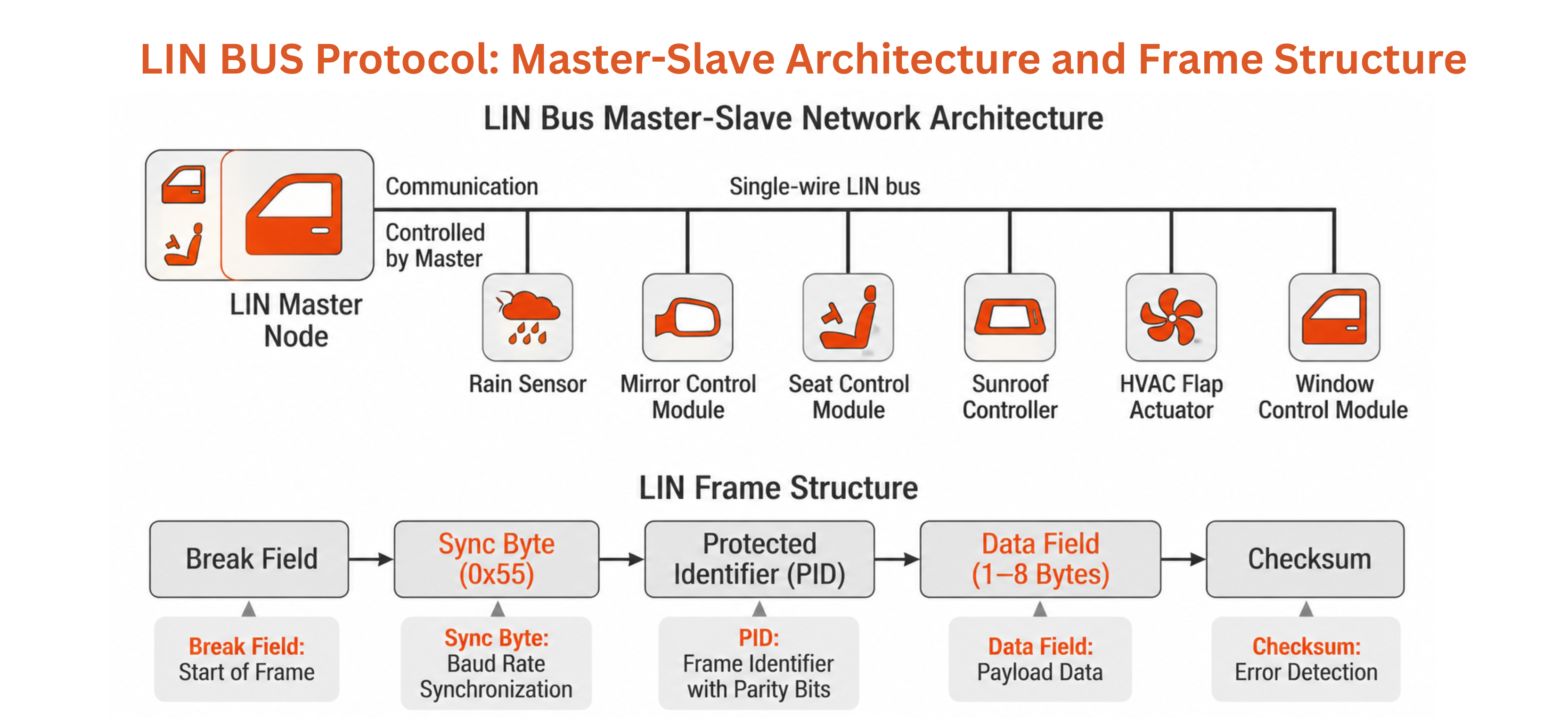
The LIN bus protocol — Local Interconnect Network — is a low-cost, single-wire automotive serial communication standard designed for body and comfort applications where the full capability of CAN bus would be excessive and expensive. Standardised under ISO 17987, the LIN bus protocol operates on a simple LIN bus master slave architecture where a single master node controls all communication scheduling, and up to 16 slave nodes respond only when addressed. Understanding the LIN frame structure, scheduling mechanism, and role of this local interconnect network in modern vehicles is essential for any automotive engineer working with body electronics or automotive sensor interfaces.
Why the LIN Bus Protocol Exists
The LIN bus protocol was developed in the late 1990s by a consortium of automotive OEMs and suppliers specifically to address a gap in the vehicle network hierarchy. CAN bus provided the performance needed for powertrain and safety systems, but its per-node cost was prohibitive for simple actuators like window motors, mirror adjusters, and seat heaters. The local interconnect network standard filled this gap with a deliberately simple design: single wire, maximum 20 kbit/s, no crystal oscillator required in slave nodes, and a straightforward LIN bus master slave architecture. The result was an automotive sensor interface technology that could be implemented at a fraction of the cost of CAN.
LIN Bus Master Slave Architecture
Every LIN bus protocol cluster has precisely one master node and between one and sixteen slave nodes. The LIN bus master slave relationship is strictly enforced — only the master can initiate communication, and it does so according to a predefined schedule table. The master cycles through this schedule, sending header frames that address each slave in turn. When a slave receives a header matching its identifier, it either reads the response data (if the frame carries a command) or transmits its own response data (if the frame carries a sensor reading). This deterministic LIN bus master slave scheduling ensures predictable latency and eliminates the need for bus arbitration — a significant simplification over CAN bus.
The LIN bus master is typically also a CAN node, bridging the local interconnect network cluster to the main vehicle CAN bus. This gateway role is how LIN bus protocol data — say, the current position of a power seat — becomes available to the rest of the vehicle network.
LIN Frame Structure
The LIN frame structure consists of a header sent by the master and a response sent by the relevant slave. Understanding the LIN frame structure is key to debugging and testing LIN bus protocol networks:
- Break Field: The LIN frame structure begins with a dominant break field — at least 13 bit-times of dominant signal — that signals all nodes a new frame is starting. This is also how slave nodes without a crystal oscillator synchronise their baud rate.
- Sync Byte: Following the break, the LIN frame structure includes a fixed sync byte (0x55) that allows slaves to measure the master's exact baud rate and adjust accordingly — eliminating the need for precise oscillators in slave nodes.
- Protected Identifier (PID): The PID in the LIN frame structure carries a 6-bit frame ID and two parity bits. The frame ID identifies which slave should respond and whether the frame carries a master command or a slave response.
- Data Field: The response portion of the LIN frame structure contains between 1 and 8 bytes of payload, transmitted either by the master (for commands) or by the addressed slave (for sensor readings).
- Checksum: The LIN frame structure closes with an 8-bit checksum covering the data field (classic checksum) or both the PID and data field (enhanced checksum in LIN 2.x).
LIN Bus Protocol Versions
| LIN Version | Key Changes | Checksum Type |
|---|---|---|
| LIN 1.x | Original specification, basic LIN frame structure | Classic (data only) |
| LIN 2.x | Enhanced diagnostics, node configuration, sleep/wake | Enhanced (PID + data) |
| ISO 17987 | International standardisation of LIN 2.x | Enhanced |
Automotive Sensor Interface Applications of LIN
The LIN bus protocol powers a remarkable range of automotive sensor interface applications. In the body domain, the local interconnect network connects rain sensors to wiper control modules, ambient light sensors to interior lighting systems, and seat occupancy sensors to airbag controllers. In comfort systems, the LIN bus master slave architecture manages seat heating elements, lumbar support motors, and mirror folding mechanisms. Climate control systems frequently use the LIN bus protocol to communicate between the HVAC module and individual duct flap actuators — each of which is a separate automotive sensor interface node on the LIN cluster.
Beyond passenger vehicles, the LIN bus protocol is used in two-wheelers, agricultural machinery, and marine applications wherever a simple, cost-effective automotive sensor interface is needed for non-critical subsystems.
Develop and Test LIN Bus Networks with Precisol
Validating a LIN bus protocol implementation — whether checking the LIN frame structure for compliance, testing LIN bus master slave timing, or diagnosing automotive sensor interface faults — requires dedicated hardware. Precisol Automation's LIN Gateway bridges the LIN bus protocol to CAN and serial interfaces for seamless integration and testing. The LIN-CAN Bus Logger captures both LIN and CAN traffic simultaneously, making it ideal for validating the master-slave gateway and the complete LIN frame structure across your cluster.
Explore how these local interconnect network tools support real-world validation in our automotive instrument cluster field testing case study, or discover how they enable rapid ECU simulator development in Precisol's application library.
Frequently Asked Questions
What is the LIN bus protocol used for in automotive systems?
The LIN bus protocol is used for low-speed, cost-sensitive automotive sensor interface and actuator applications — window motors, mirror adjusters, seat heaters, rain sensors, and climate vent actuators. These are subsystems where the local interconnect network's simplicity is preferred over CAN's complexity.
How does LIN bus master slave communication work?
In LIN bus master slave communication, the master controls all scheduling. It sends a header (break + sync + PID) and the addressed slave responds with data. No slave can initiate communication independently — all LIN bus protocol traffic is driven by the master's schedule table.
What is the maximum speed of the LIN bus protocol?
The LIN bus protocol operates at a maximum of 20 kbit/s as defined by ISO 17987. This is by design — lower speeds allow slave nodes to synchronise from the LIN frame structure's break field without a dedicated crystal oscillator, which is key to keeping the local interconnect network cost-effective.