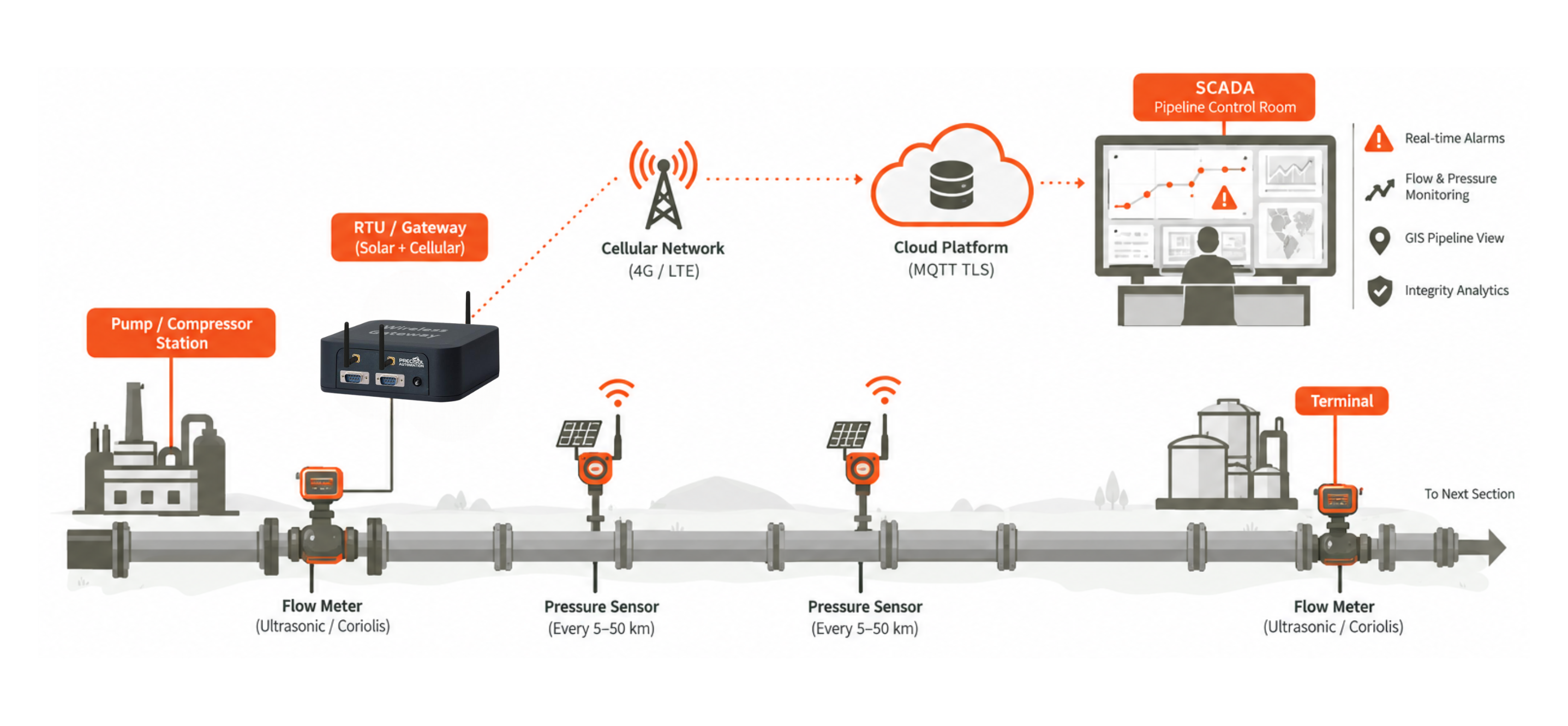
Oil gas pipeline monitoring IoT systems have become critical infrastructure for pipeline operators managing thousands of kilometres of crude oil, refined products, and natural gas transmission pipelines — where undetected leaks not only represent significant product loss and environmental damage but carry regulatory, legal, and reputational consequences that can be catastrophic. The US Pipeline and Hazardous Materials Safety Administration (PHMSA) regulations and ATEX/IECEx requirements for hazardous area instrumentation, combined with growing ESG accountability for fugitive emissions and spill response times, have driven widespread adoption of dense sensor networks and real-time oil gas pipeline monitoring IoT platforms that give operators continuous visibility across their entire pipeline corridor. Traditional SCADA systems with fixed RTUs at pump stations provided pressure monitoring only at compressor and pump station boundaries — pipeline leak detection IoT systems now add intermediate monitoring points every 5–50 km with solar-powered, cellular-connected pressure and flow sensors that fill the surveillance gaps between stations. Connecting this field sensor network to a modern oil gas remote monitoring system combining SCADA real-time operations with cloud analytics enables both the immediate leak alarm response required by regulations and the long-term pipeline integrity management that prevents leaks before they occur. This guide covers the sensor technologies, IoT communication architectures, SCADA pipeline oil gas integration patterns, and pipeline pressure monitoring IIoT algorithms used in modern pipeline monitoring deployments.
Oil Gas Pipeline Monitoring IoT: Key Technologies
- Pressure Monitoring — Foundation of Pipeline Leak Detection IoT: Pipeline pressure monitoring IIoT is the core measurement in any oil gas pipeline monitoring IoT system. Electronic pressure transmitters with HART or 4–20 mA output installed at intermediate monitoring points every 5–50 km transmit real-time pressure readings to RTUs or IIoT gateways via cable or wireless. Pipeline leak detection IoT using pressure balance algorithms compares inlet and outlet flows with expected line pack — a deficit indicates product loss. Negative pressure wave (NPW) detection using high-sample-rate pressure sensors (1–10 Hz) detects the rarefaction wave generated by a leak and triangulates its position from wave arrival time differences at adjacent sensors.
- Flow Measurement — Custody Transfer and Balance: Ultrasonic and Coriolis flow meters at pump stations and terminals provide the mass flow balance that is the primary pipeline leak detection IoT method for slow seeping leaks that don't generate pressure transients. Oil gas remote monitoring system flow balance calculations compare metered inlet volumes against metered outlet volumes corrected for line pack changes — sustained imbalance exceeding threshold (typically 0.25–1% of flow) triggers leak investigation. Modbus RTU output from flow meter transmitters connects to IIoT gateways for transmission to SCADA and cloud.
- Remote RTU and IIoT Gateway Communications: Intermediate monitoring points on cross-country pipelines require solar-powered RTUs or IIoT gateways with cellular (4G LTE) or satellite communications — mains power is unavailable along most pipeline corridors. Oil gas pipeline monitoring IoT communication reliability requirements are stringent: SCADA polling latency must be under 10 seconds for NPW leak detection; communication outages must trigger an alarm distinguishable from a pressure drop event. Dual-SIM cellular gateways with automatic carrier switching and satellite backup are standard in production oil gas remote monitoring system deployments.
- SCADA Pipeline Oil Gas Integration: SCADA pipeline oil gas systems aggregate all field RTU data into a real-time GIS pipeline model with colour-coded pressure profile displays, flow balance dashboards, and alarm management. DNP3 over SCADA WAN is the standard protocol for pipeline SCADA communications. Modern deployments add a parallel cloud analytics layer — oil gas pipeline monitoring IoT cloud platform receiving data via MQTT TLS from field gateways, enabling ML-based anomaly detection, remote monitoring dashboards for operations staff, and long-term pipeline integrity trend analysis without SCADA VPN access.
Pipeline Leak Detection IoT: Detection Methods
| Detection Method | Leak Size Detected | Oil Gas Pipeline Monitoring IoT Requirement |
|---|---|---|
| Pressure balance (line pack) | Leaks >0.5% of flow rate | Pressure transmitters at stations; SCADA pipeline oil gas flow balance model |
| Negative pressure wave (NPW) | Sudden ruptures and large leaks | Pipeline pressure monitoring IIoT at 1–10 Hz; adjacent sensor pairs every 10–30 km |
| Flow balance (metered) | Slow seeping leaks >0.25% flow | Ultrasonic/Coriolis meters at terminals; oil gas remote monitoring system mass balance |
| Computational Pipeline Monitoring (CPM) | Leaks >1–3% flow with 5–15 min response | Dense pressure/flow sensors; real-time hydraulic simulation in SCADA pipeline oil gas |
Oil Gas Pipeline Monitoring IoT with Precisol Automation
Precisol Automation's Wireless Pressure Sensor provides pipeline pressure monitoring IIoT capability for intermediate monitoring points — battery or solar-powered, cellular-connected, with Modbus RTU interface to field RTUs and direct cloud connectivity for oil gas pipeline monitoring IoT deployments without existing SCADA infrastructure at the monitoring point. The Serial IIoT Gateway connects existing pressure transmitters, flow meters, and RTUs via Modbus RTU/TCP and publishes data via MQTT TLS to cloud dashboards, enabling the cloud analytics layer of a dual-path oil gas remote monitoring system.
See IT-OT integration in our IT-OT bridge for process automation case study, or explore remote monitoring for Modbus PLCs for the IIoT gateway communication pattern used in SCADA pipeline oil gas integration deployments.
Frequently Asked Questions
How does IoT pipeline monitoring detect leaks in oil and gas pipelines?
Oil gas pipeline monitoring IoT detects leaks via pressure differential analysis — transmitters every 5–50 km feed real-time pressure to SCADA pipeline oil gas systems running flow balance algorithms (inlet flow = outlet flow + line pack change; deficit = leak). Negative pressure wave detection uses high-frequency (1–10 Hz) pipeline pressure monitoring IIoT sensors to detect and triangulate the rarefaction wave generated by a rupture. Pipeline leak detection IoT algorithms achieve 0.25–1% of flow rate sensitivity for sustained leaks.
What sensors are used in oil and gas pipeline monitoring IoT systems?
Oil gas pipeline monitoring IoT uses: pressure transmitters (4–20 mA/HART, 0–250 bar) for pipeline pressure monitoring IIoT at stations and intermediate points; ultrasonic and Coriolis flow meters at terminals for mass balance pipeline leak detection IoT; RTDs for temperature; cathodic protection monitors; and geotechnical sensors in subsidence zones. All connect via Modbus RTU or HART to RTUs and IIoT gateways for SCADA and oil gas remote monitoring system integration via cellular or satellite.
How is SCADA integrated with IoT for oil and gas pipeline monitoring?
SCADA pipeline oil gas receives DNP3 data from field RTUs via cellular/satellite WAN, aggregating into a GIS pipeline pressure and flow model with real-time pipeline leak detection IoT alarms. A parallel cloud layer in the oil gas remote monitoring system receives MQTT TLS data from IIoT gateways for ML anomaly detection and remote dashboards without SCADA VPN. Alarm handshaking ensures pipeline leak detection IoT events in cloud immediately trigger SCADA pipeline oil gas operator alerts for emergency response.