Motor health monitoring is a predictive maintenance discipline that uses IoT sensors to continuously track the condition of electric motors — catching overheating, bearing degradation, current imbalance, and rotor faults before they progress to failure and cause unplanned production downtime. Electric motors are the workhorses of industrial production: they drive pumps, compressors, fans, conveyors, and mixers — and when they fail unexpectedly, the consequences ripple through the entire production process. Motor condition monitoring with permanently installed sensors provides the continuous, real-time data that enables electric motor fault detection weeks ahead of failure, converting costly emergency repairs into planned maintenance events. The key parameters tracked in motor health monitoring — vibration, winding temperature, current signature, and power factor — together provide a comprehensive picture of motor health that no single measurement can deliver alone.
Why Motors Fail and What Motor Health Monitoring Detects
Understanding the failure modes that motor health monitoring targets helps in selecting the right sensor suite and interpreting the data correctly. The major causes of electric motor failure, and the motor condition monitoring parameters that detect them:
- Bearing Failure (40–50% of failures): Vibration monitoring detects bearing degradation through characteristic defect frequencies in the FFT spectrum. Motor health monitoring systems alert when vibration at bearing defect frequencies rises above baseline — typically 2–6 weeks before catastrophic bearing failure.
- Winding Insulation Degradation (30% of failures): Motor thermal monitoring of winding temperature detects overheating — the primary cause of insulation aging. Every 10°C rise above rated temperature halves insulation life. Motor condition monitoring ensures winding temperature stays within design limits.
- Broken Rotor Bars: Motor current analysis detects broken rotor bars through characteristic sidebands in the stator current spectrum. Electric motor fault detection via motor current analysis is non-invasive — only a current transformer is needed, with no sensor touching the motor body.
- Misalignment and Imbalance: Shaft misalignment and mechanical imbalance generate elevated vibration at specific frequencies — 1× shaft speed for imbalance, 2× shaft speed for angular misalignment. Motor health monitoring vibration analysis identifies these mechanical issues early.
Motor Current Analysis: Non-Invasive Electric Motor Fault Detection
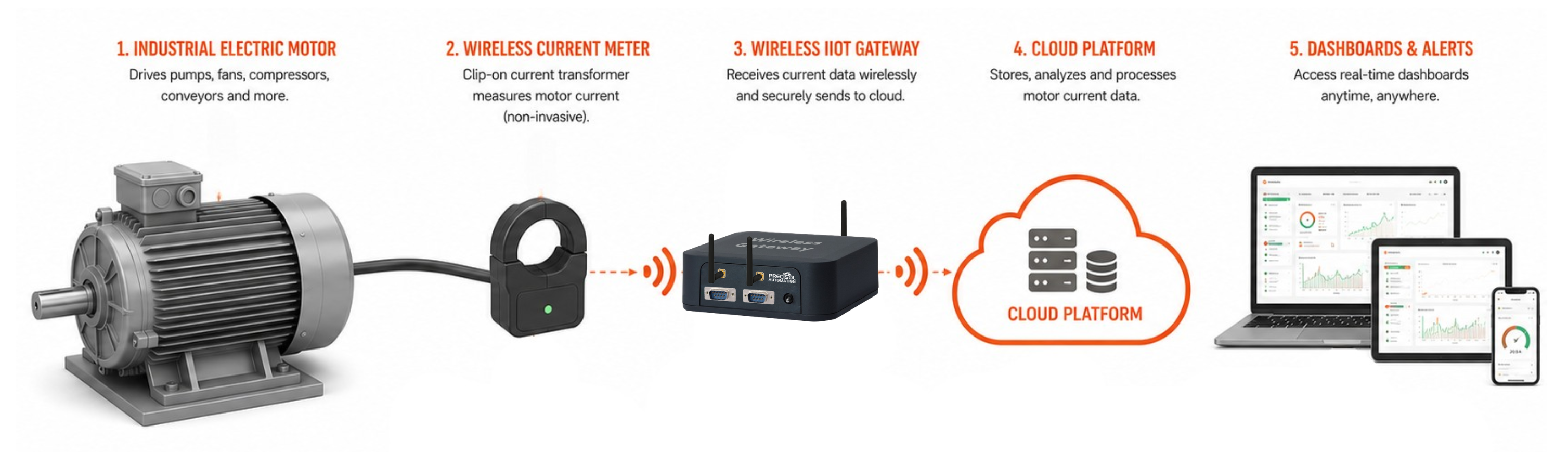
Motor current analysis is one of the most powerful tools in the motor health monitoring toolkit because it requires only a non-contact current transformer clamped around one motor supply conductor — no sensors on the motor body, no shutdown for installation. A wireless or wired current meter measures the current waveform drawn by the motor, and the motor current analysis platform analyses it for:
| Fault Type | Motor Current Analysis Signature | Electric Motor Fault Detection Method |
|---|---|---|
| Broken Rotor Bars | Sidebands at fundamental ± 2×slip frequency | FFT of stator current in motor current analysis |
| Phase Imbalance | Unequal current magnitudes across phases | Per-phase RMS monitoring in motor health monitoring |
| Overloading | Sustained current above rated FLA | Current threshold alert in motor condition monitoring |
| Single Phasing | One phase current drops to zero | Immediate electric motor fault detection alert |
| Power Factor Degradation | Increasing reactive current draw | Power factor trend in motor health monitoring platform |
Motor Thermal Monitoring: Protecting Winding Insulation
Motor thermal monitoring uses temperature sensors on the motor frame or winding (where accessible) to track heat build-up. The relationship between temperature and insulation life is well established — Class F insulation (155°C rated) loses half its remaining life for every 10°C of sustained overtemperature. Motor thermal monitoring in a motor health monitoring system alerts when winding temperature rises above normal operating range, triggering investigation before damage accumulates. Thermal trending over weeks identifies gradual deterioration of cooling efficiency — a blocked air intake, failing cooling fan, or increasing load — before the temperature reaches damaging levels. Motor condition monitoring with temperature trending detects cooling degradation months before it causes insulation failure.
Deploy Motor Health Monitoring with Precisol Automation
Precisol Automation's Wireless Current Meter provides non-invasive motor current analysis capability via a clip-on current transformer — transmitting per-phase current data wirelessly to the cloud for electric motor fault detection without any wiring to the motor panel. Paired with the Serial IIoT Gateway, temperature and vibration sensor data is integrated into a unified motor health monitoring stream for comprehensive motor condition monitoring coverage.
See motor health monitoring preventing unplanned shutdowns in our industrial machine health monitoring case study, or explore how Precisol enables wireless current meter for industrial motor monitoring with non-invasive motor current analysis.
Frequently Asked Questions
What parameters are monitored in motor health monitoring?
Motor health monitoring tracks vibration (bearing and mechanical faults), winding temperature (motor thermal monitoring), current draw (motor current analysis for rotor and phase faults), and power factor. Electric motor fault detection platforms combine these parameters to flag deviations from normal baselines weeks before failure.
How does motor current analysis detect faults?
Motor current analysis monitors the stator current waveform drawn by the motor. FFT analysis of the current signal reveals characteristic sidebands from broken rotor bars, phase imbalance patterns, and overloading — all forms of electric motor fault detection without any mechanical sensor on the motor body. Only a clip-on current transformer is required for motor health monitoring.
What is the most common cause of electric motor failure?
Bearing failure causes 40–50% of motor breakdowns; winding insulation degradation from thermal stress accounts for ~30%. Motor health monitoring addresses both: vibration monitoring detects bearing wear early, while motor thermal monitoring and motor current analysis detect winding stress before insulation failure, making electric motor fault detection actionable weeks in advance.