Vibration Analysis for Predictive Maintenance: A Practical Guide
21 July 2026
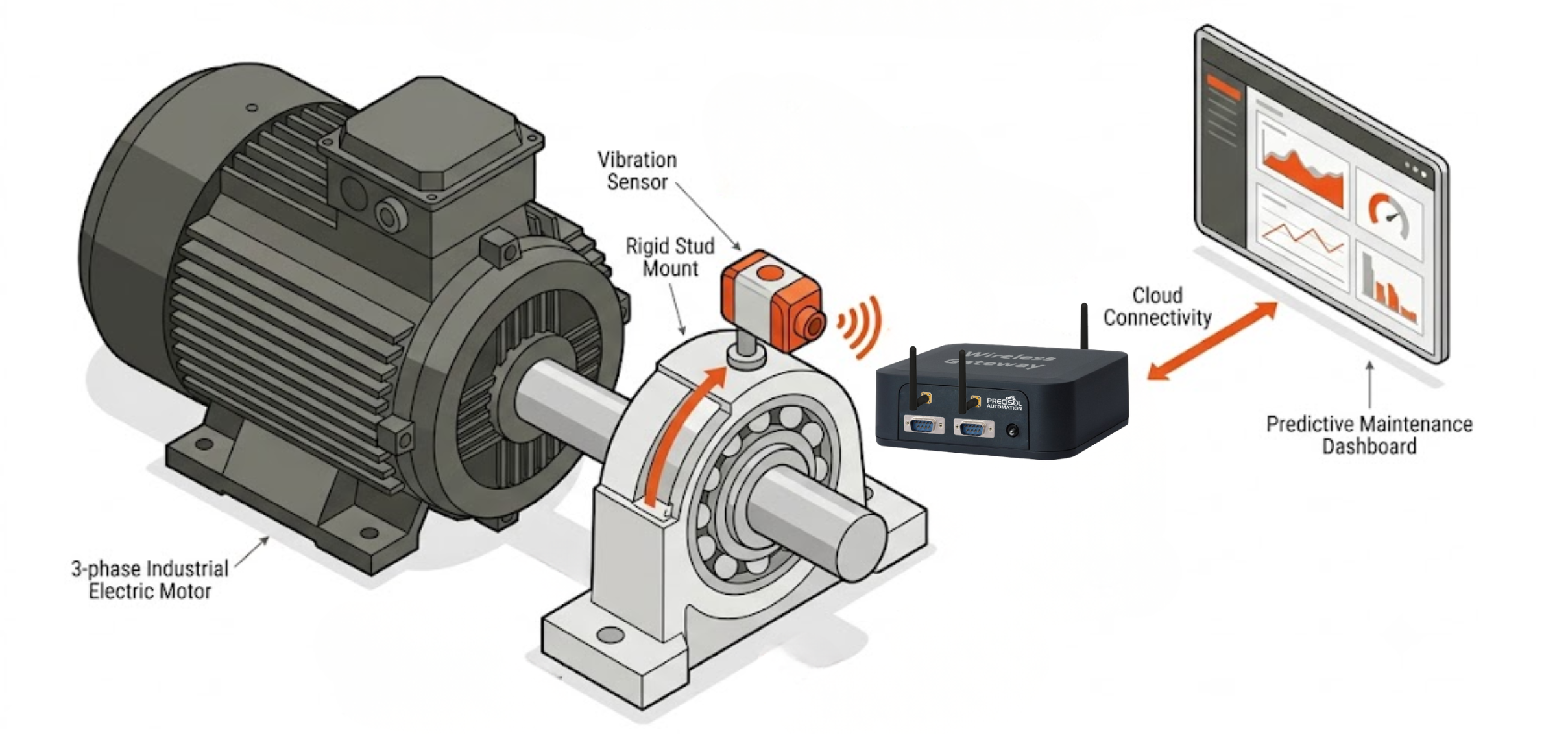
Vibration analysis is the most widely used technique in industrial predictive maintenance programmes — and for good reason. Rotating machinery generates characteristic vibration patterns that change measurably as mechanical faults develop, often weeks or months before failure occurs. Vibration monitoring with permanently installed or portable machine vibration sensors captures these changes continuously, while FFT vibration analysis decomposes the raw signal into frequency components that identify the specific type of fault developing. Bearing fault detection is the most common application — bearings are the most failure-prone component in rotating machinery, and vibration analysis can detect inner race, outer race, and rolling element defects when they are still microscopic, giving maintenance teams time to plan a safe, scheduled replacement before a catastrophic failure shuts down production.
What Vibration Analysis Measures
A machine vibration sensor (accelerometer) converts mechanical vibration into an electrical signal proportional to the acceleration of the measurement point. Vibration monitoring systems record this signal continuously or periodically and characterise it in several ways:
- Overall Vibration Level (RMS): The overall vibration energy in a frequency band. Trending the RMS level over time is the simplest form of vibration monitoring — a rising trend indicates developing mechanical problems. ISO 10816 provides reference thresholds for acceptable vibration levels by machine class.
- FFT Spectrum: FFT vibration analysis decomposes the raw signal into its constituent frequencies, revealing the vibration energy at each frequency. This is the most diagnostic form of vibration analysis — each fault type (imbalance, misalignment, looseness, bearing defects) produces energy at specific, calculable frequencies in the FFT spectrum.
- Envelope Analysis (High-Frequency Demodulation): Particularly effective for bearing fault detection at early stages, envelope analysis filters the vibration signal to a high-frequency band where bearing impacts are dominant, then demodulates and FFT-analyses the envelope to extract bearing defect frequencies even when masked by low-frequency machine noise.
- Waveform Analysis: Time-domain vibration waveforms reveal impulsive events (bearing impacts, gear tooth damage) and looseness (non-linearity in the vibration waveform). Crest factor and kurtosis metrics quantify the impulsiveness of the vibration monitoring signal.
Bearing Fault Detection with FFT Vibration Analysis
Bearing fault detection is the core application of vibration analysis in predictive maintenance. Rolling element bearing defects generate vibration at characteristic frequencies determined by the bearing geometry and shaft speed:
| Defect Location | Frequency (Abbreviation) | Vibration Analysis Signature |
|---|---|---|
| Outer Race | BPFO (Ball Pass Frequency Outer) | Most common in FFT vibration analysis; repeatable at shaft speed × (N/2) × (1 − d/D cosα) |
| Inner Race | BPFI (Ball Pass Frequency Inner) | Bearing fault detection shows sidebands at BPFI ± shaft speed (modulation by shaft rotation) |
| Rolling Element | BSF (Ball Spin Frequency) | Modulated at cage frequency in FFT vibration analysis spectrum |
| Cage | FTF (Fundamental Train Frequency) | Low-frequency vibration monitoring component; often first indicator of lubrication failure |
Effective bearing fault detection requires the machine vibration sensor sampling rate to be at least twice the highest frequency of interest — typically 10–20 kHz for rolling element bearing fault detection via FFT vibration analysis.
Machine Vibration Sensor Placement Best Practices
The quality of vibration analysis data depends heavily on how and where the machine vibration sensor is mounted. Key vibration monitoring sensor placement rules:
- Mount on the Bearing Housing: Place the machine vibration sensor directly on the bearing housing — the load path from the bearing race to the sensor must be as short and rigid as possible for accurate bearing fault detection.
- Measure in Three Axes: Radial horizontal, radial vertical, and axial measurements provide complete vibration analysis coverage — imbalance shows radially, misalignment shows axially, and bearing fault detection requires both.
- Rigid Mounting: For FFT vibration analysis above 2 kHz (essential for early bearing fault detection), use stud or adhesive mounting — magnetic mounts introduce resonances that corrupt high-frequency vibration monitoring data.
- Avoid Structural Resonances: Locate the machine vibration sensor away from thin panels or brackets that may resonate and contaminate the vibration analysis spectrum with structure-borne noise.
Start Vibration Analysis and Vibration Monitoring with Precisol
Precisol Automation provides wireless vibration sensors that attach directly to machine bearing housings and transmit vibration monitoring data — overall RMS level, waveform, and FFT vibration analysis spectra — to a wireless gateway for cloud processing. No wiring to the machine is required, making vibration analysis deployment fast and non-intrusive even on running equipment. The Serial IIoT Gateway supports wired accelerometer and vibration transmitter inputs for applications requiring continuous high-frequency vibration analysis and bearing fault detection.
See vibration monitoring and predictive maintenance reducing unplanned downtime in our industrial machine health monitoring case study, or explore how Precisol enables proactive maintenance of construction equipment with field-deployed vibration analysis.
Frequently Asked Questions
What does vibration analysis detect in industrial machinery?
Vibration analysis detects bearing fault conditions (inner/outer race, rolling element), imbalance, misalignment, looseness, and gear mesh faults. FFT vibration analysis identifies fault-specific frequencies from machine vibration sensor data, enabling bearing fault detection and other fault diagnosis weeks before failure.
How does FFT vibration analysis detect bearing faults?
FFT vibration analysis converts machine vibration sensor time-domain data to the frequency domain. Each bearing defect generates energy at a calculable characteristic frequency (BPFO, BPFI, BSF, FTF). Bearing fault detection identifies peaks at these frequencies in the FFT spectrum, revealing the defect type and progression weeks ahead of failure.
Where should machine vibration sensors be placed for best results?
Machine vibration sensors should be mounted rigidly on bearing housings, measuring in radial horizontal, radial vertical, and axial directions. For FFT vibration analysis and bearing fault detection above 2 kHz, stud or adhesive mounting is required — magnetic mounts reduce high-frequency vibration monitoring accuracy.