MQTT Protocol for Industrial IoT: A Practical Implementation Guide
10 July 2026
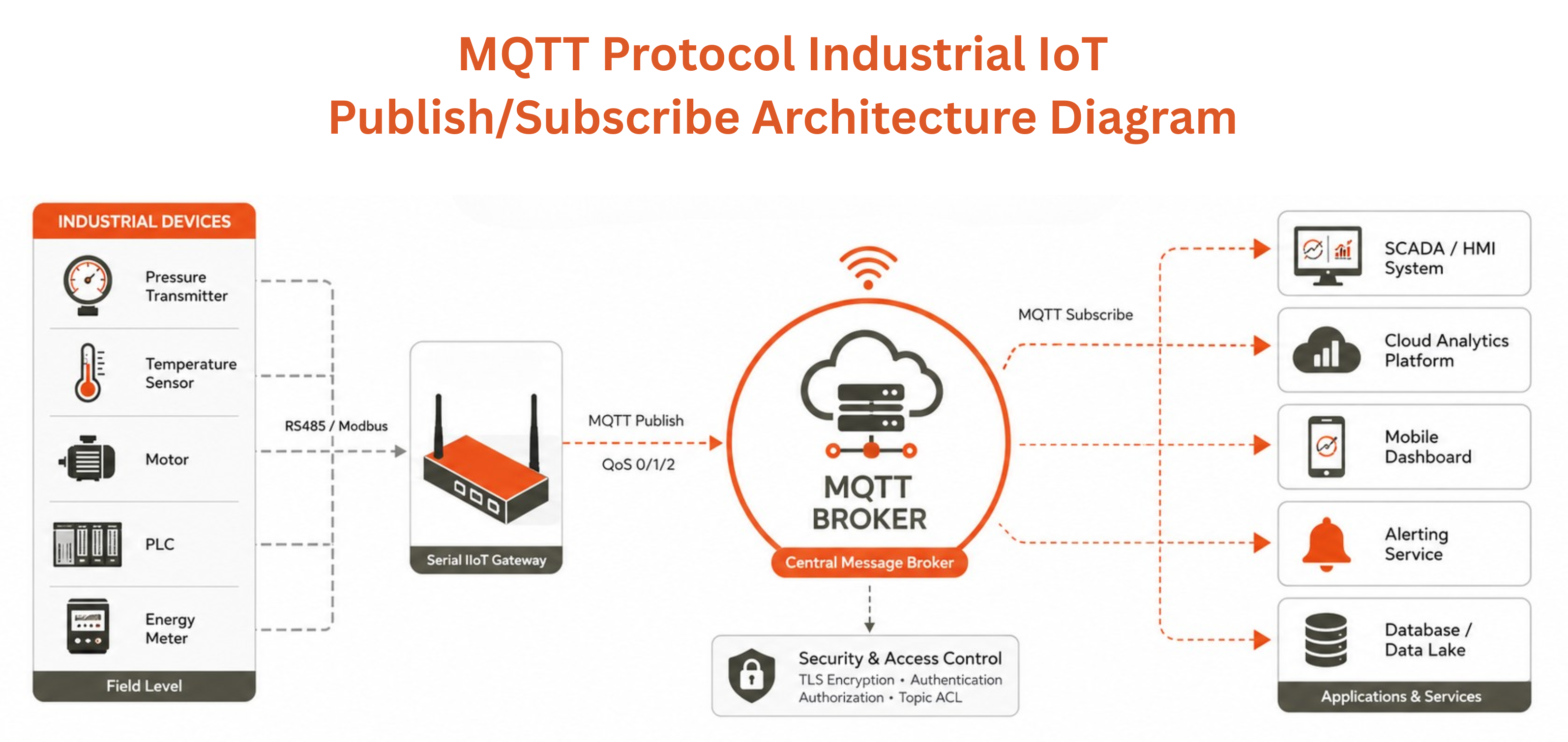
The MQTT protocol industrial IoT ecosystem has rapidly become the dominant messaging standard connecting factory floor devices to cloud analytics platforms. MQTT (Message Queuing Telemetry Transport) is a lightweight IoT messaging protocol built on the MQTT publish subscribe pattern — where devices publish data to an MQTT broker, and any number of cloud applications, dashboards, or control systems subscribe to receive that data. The MQTT protocol industrial IoT combination is powerful precisely because MQTT was designed as a lightweight IoT protocol for constrained devices and unreliable networks — exactly the conditions found at the industrial edge.
Why MQTT Protocol Industrial IoT Adoption Is Accelerating
Traditional industrial protocols like Modbus and CAN bus were designed for deterministic, point-to-point communication in closed networks. The MQTT protocol industrial IoT architecture takes a fundamentally different approach: any device can publish data to any topic, and any application can subscribe to any topic, through the central MQTT broker. This decoupling is transformative for industrial IoT because it means a single IIoT gateway publishing to the MQTT broker makes its machine data instantly available to a SCADA system, a cloud analytics platform, a mobile dashboard, and an alerting service simultaneously — without any of these consumers needing to communicate directly with the gateway. New consumers can be added without modifying the publisher, making the MQTT publish subscribe model ideal for evolving industrial IoT architectures.
The MQTT protocol's header overhead is as small as 2 bytes — far less than HTTP REST APIs or OPC UA TCP binary. This lightweight IoT protocol design means IIoT gateways running on cellular connections can publish data frequently without incurring prohibitive data costs. At the MQTT broker level, modern brokers like Mosquitto, HiveMQ, and AWS IoT Core handle millions of MQTT publish subscribe connections simultaneously.
MQTT Broker: The Hub of Industrial IoT Messaging
The MQTT broker is the central routing engine of every MQTT protocol industrial IoT deployment. It receives all published messages from connected devices, matches them against active subscriptions, and delivers copies to every matching subscriber. The MQTT broker maintains session state for clients, buffers messages for offline subscribers (based on QoS level), and enforces access control policies. Choosing the right MQTT broker architecture is critical for scalable industrial IoT:
- On-Premise MQTT Broker: An MQTT broker running on a local server or edge device keeps data within the plant network — important for bandwidth-constrained sites or where data sovereignty requirements prohibit cloud transmission. Eclipse Mosquitto is the most widely used open-source MQTT broker for on-premise industrial IoT deployments.
- Cloud MQTT Broker: Managed MQTT broker services (AWS IoT Core, Azure IoT Hub, HiveMQ Cloud) provide scalable MQTT publish subscribe infrastructure without the operational burden of self-hosting. Cloud MQTT broker services integrate natively with analytics services, databases, and alerting systems.
- Edge MQTT Broker + Cloud Bridge: The most resilient MQTT protocol industrial IoT architecture runs a local MQTT broker at the plant and bridges selected topics to the cloud MQTT broker. This ensures local systems continue operating when the internet connection fails, while cloud applications still receive data when connectivity is available.
MQTT Topic Design for Industrial IoT
MQTT topics are hierarchical strings that organise the MQTT publish subscribe namespace. Well-designed topics make industrial IoT systems maintainable and scalable. A recommended pattern for MQTT protocol industrial IoT topic design:
| Level | Example | Represents |
|---|---|---|
| Site | plant/chennai/ | Physical facility identifier |
| Machine | plant/chennai/compressor-1/ | Individual asset |
| Signal | plant/chennai/compressor-1/pressure | Individual measurement published to MQTT broker |
| Status | plant/chennai/compressor-1/status | Running state — wildcard subscribable with MQTT publish subscribe +/# |
MQTT QoS Levels: Choosing Reliability vs Overhead
The lightweight IoT protocol MQTT offers three Quality of Service levels that balance delivery reliability against network overhead — an important trade-off for MQTT protocol industrial IoT over cellular or congested networks:
- QoS 0 (At Most Once): The MQTT broker delivers each message at most once. No acknowledgement, no retry — the lowest overhead lightweight IoT protocol mode. Use for high-frequency sensor data where occasional loss is acceptable.
- QoS 1 (At Least Once): The MQTT broker guarantees delivery but may deliver duplicates. The publisher retransmits until acknowledged. This is the most common choice for MQTT protocol industrial IoT machine data and alert messages.
- QoS 2 (Exactly Once): A four-step handshake guarantees exactly-once delivery to the MQTT broker. Highest overhead — use for commands or setpoints where duplicates would cause incorrect actions.
Publish Industrial Machine Data via MQTT with Precisol Automation
Precisol Automation's Serial IIoT Gateway collects data from RS485 Modbus devices and publishes it to any MQTT broker — on-premise or cloud — as part of a complete MQTT protocol industrial IoT pipeline. Payload format (JSON, CSV, binary), topic structure, QoS level, and publish interval are all configurable without firmware changes. Pair it with the PreciCloud IoT Cloud Dashboard for an end-to-end MQTT publish subscribe solution with real-time visualisation and alerting built in.
See MQTT protocol industrial IoT connectivity enabling continuous machine monitoring in our industrial machine health monitoring case study, or explore how Precisol powers smart energy metering with MQTT broker-based cloud reporting.
Frequently Asked Questions
Why is MQTT protocol popular for Industrial IoT?
The MQTT protocol industrial IoT adoption is driven by its lightweight IoT protocol design — 2-byte minimum headers — and MQTT publish subscribe architecture that decouples publishers from subscribers via the MQTT broker. This makes it ideal for bandwidth-constrained edge devices publishing machine data to multiple cloud consumers simultaneously.
What is an MQTT broker and how does it work?
An MQTT broker is the central routing server in the MQTT publish subscribe architecture. Publishers send messages to topics; the MQTT broker matches and delivers them to all subscribers. The MQTT broker decouples producers from consumers and buffers messages for offline subscribers based on QoS level.
What are MQTT QoS levels and which should I use?
MQTT protocol defines QoS 0 (at most once), QoS 1 (at least once), and QoS 2 (exactly once). For MQTT protocol industrial IoT machine data, QoS 1 is most common — delivering reliable lightweight IoT protocol messaging via the MQTT broker without the overhead of exactly-once semantics.