OPC UA Protocol: The Modern Standard for Industrial Interoperability
09 July 2026
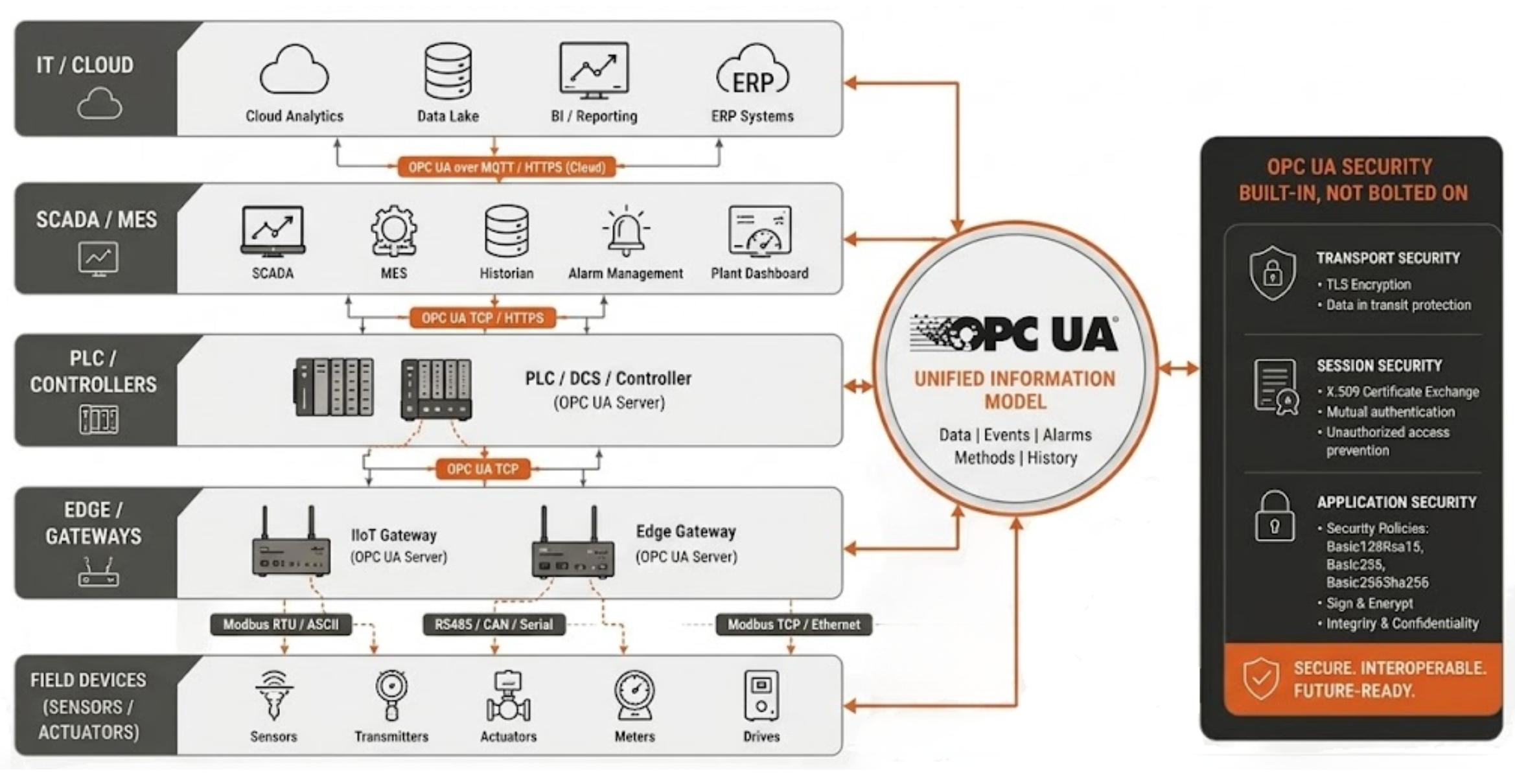
The OPC UA protocol (OPC Unified Architecture) is the de facto Industry 4.0 standard for secure, vendor-neutral data communication across the entire industrial automation pyramid — from PLCs and edge devices to SCADA, MES, ERP, and cloud platforms. Developed by the OPC Foundation and standardised as IEC 62541, the OPC UA protocol solves the most persistent challenge in industrial automation: industrial interoperability across heterogeneous systems from different vendors, different generations, and different communication layers. Unlike its predecessor OPC Classic, the OPC UA protocol is platform-independent, firewall-friendly, and ships with built-in OPC UA security — making it the cornerstone of OT IT integration in modern smart factories.
Why Industrial Interoperability Is So Difficult
Industrial automation environments are built over decades, layer by layer. A typical plant contains PLCs from multiple vendors running proprietary protocols, SCADA systems from different generations, historians using incompatible data formats, and IT enterprise systems that speak REST APIs and SQL. Achieving industrial interoperability across this landscape has historically required custom middleware, point-to-point integrations, and constant maintenance as systems evolve. The OPC UA protocol was designed specifically to solve this by providing a single, standardised communication layer that any vendor can implement on any platform — from a microcontroller-class device to a cloud server — enabling true industrial interoperability without proprietary intermediaries.
Core Architecture of the OPC UA Protocol
The OPC UA protocol is built on an information model — a structured, hierarchical address space where all data, events, methods, and historical values are represented as nodes with well-defined types and relationships. This information model is the key to industrial interoperability: rather than defining flat register maps (like Modbus) or proprietary object structures (like some PLCs), the OPC UA protocol defines a type system that allows complex industrial data — an entire machine's operational state, including sub-components, parameters, and status — to be exposed in a standardised, self-describing way that any OPC UA client can browse and consume without prior knowledge of the device's internal structure.
The OPC UA protocol supports multiple transport mappings: OPC UA TCP (binary, most efficient for plant-floor OT IT integration), HTTPS (for firewall-friendly web service communication), and WebSockets (for browser-based clients). All transport mappings share the same information model and OPC UA security framework.
OPC UA Security: Built-In, Not Bolted On
OPC UA security is one of the most significant advantages over all predecessor industrial communication protocols. The OPC UA protocol specification defines security at three levels:
- Transport Security: OPC UA security uses TLS encryption over all transport channels, protecting data in transit between client and server against eavesdropping and man-in-the-middle attacks.
- Session Security: OPC UA security requires X.509 certificate exchange before establishing a session. Both client and server present certificates that must be validated — preventing unauthorised devices from connecting to OPC UA servers on the plant network.
- Application Layer Security: OPC UA security policies define the combination of algorithms used: Basic128Rsa15, Basic256, or Basic256Sha256 (recommended). Messages can be signed only (integrity without confidentiality) or signed and encrypted (full OPC UA security). The None policy is available but should never be used in production OT IT integration environments.
OPC UA Protocol as the Industry 4.0 Standard
| Layer | OPC UA Protocol Role | OT IT Integration Benefit |
|---|---|---|
| Field Devices (Sensors, Actuators) | Embedded OPC UA server on IIoT gateways | Industrial interoperability from the field device upward |
| PLC / Controller | Native OPC UA server on modern PLCs | Direct SCADA connectivity without OPC Classic middleware |
| SCADA / MES | OPC UA client consuming multiple server data | Unified industrial interoperability across all plant assets |
| Cloud / Enterprise | OPC UA over MQTT (OPC UA PubSub) | Scalable OT IT integration with cloud analytics platforms |
The OPC UA protocol's companion specifications — standardised information models for specific industry domains including PackML for packaging, ISA-95 for manufacturing, and OPC UA for Machinery — accelerate industrial interoperability within those domains by defining common data structures that all compliant devices share.
Achieve OT IT Integration with Precisol's OPC UA-Ready Gateways
Implementing the OPC UA protocol from field level to cloud requires gateways that can translate between legacy field protocols (Modbus, RS485, CAN) and OPC UA's rich information model. Precisol Automation's Serial IIoT Gateway supports OPC UA server functionality alongside Modbus RTU collection, enabling industrial interoperability between legacy serial networks and any OPC UA client — SCADA, MES, or cloud analytics. The RS485 Serial IIoT Edge Gateway complements this with edge analytics capabilities, filtering and pre-processing data before exposing it via OPC UA for OT IT integration.
See the OPC UA protocol enabling complete OT IT integration in our IT-OT bridge for process automation case study, or explore how Precisol facilitates remote Modbus PLC monitoring with OPC UA industrial interoperability.
Frequently Asked Questions
What is the OPC UA protocol used for?
The OPC UA protocol enables secure, platform-independent industrial interoperability between PLCs, SCADA, MES, ERP, and cloud systems. It is the primary Industry 4.0 standard for OT IT integration, replacing proprietary middleware with a single vendor-neutral communication layer across the entire automation pyramid.
How does OPC UA security work?
OPC UA security is built into the protocol specification. It includes X.509 certificate authentication, AES encryption, and message signing — configured through security policies from Basic128Rsa15 to Basic256Sha256. OPC UA security is far more robust than OPC Classic DCOM security and is designed for production OT IT integration environments.
Is OPC UA protocol the same as OPC Classic (OPC DA)?
No. OPC Classic was Windows-specific and used DCOM. The OPC UA protocol is a complete rewrite — platform-independent, firewall-friendly, with built-in OPC UA security. OPC UA is the designated Industry 4.0 standard successor to all OPC Classic variants, providing true industrial interoperability across all platforms and operating systems.