Serial to Wi-Fi Gateway: Wirelessly Connecting Legacy Industrial Equipment
13 July 2026
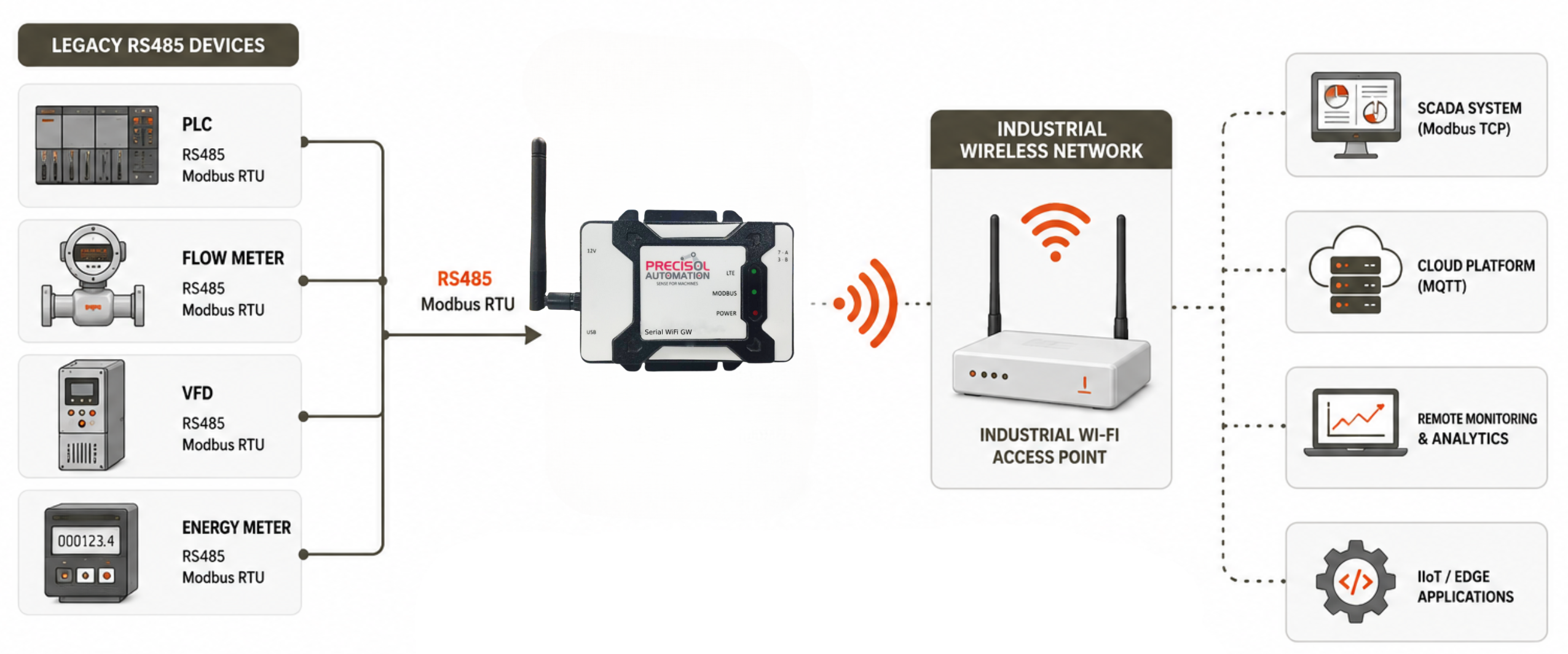
A serial to WiFi gateway is a compact hardware device that converts RS232 or RS485 serial communication to wireless 802.11 Wi-Fi, enabling legacy device connectivity to modern IP networks without running new Ethernet cables. For industrial facilities filled with equipment that communicates only via RS485 or RS232 serial ports, a serial to WiFi gateway transforms the economics of wireless serial communication: instead of trenching conduit for new wiring, an RS485 WiFi adapter connects to the existing serial port and joins the plant's industrial wireless network instantly. The result is complete legacy device connectivity to SCADA, cloud analytics, and remote monitoring platforms — without replacing or modifying the legacy equipment.
The Legacy Device Connectivity Challenge
Industrial facilities accumulate decades of equipment investment. A compressor installed in 2005, a flow meter from 2010, and a PLC from 2015 all communicate via RS485 Modbus RTU. None of them have Ethernet ports. Achieving legacy device connectivity to a modern cloud IoT platform traditionally meant running new Ethernet cable to each device — expensive, disruptive, and often physically impractical in complex plant layouts. A serial to WiFi gateway eliminates this barrier. The RS485 WiFi adapter connects to the device's existing serial port, joins the plant industrial wireless network, and makes that device's data available to any IP-based system — SCADA, MQTT broker, cloud dashboard — without a single metre of new cable.
How a Serial to WiFi Gateway Works
A serial to WiFi gateway operates as a transparent bridge between the serial world and the IP world. On the serial side, the gateway connects to the device's RS232 or RS485 port and receives data in the device's native serial communication protocol — Modbus RTU, ASCII, or raw serial. On the wireless side, the serial to WiFi gateway associates with the plant industrial wireless network access point and transmits that serial data encapsulated in TCP or UDP packets over Wi-Fi.
The most common wireless serial communication modes in a serial to WiFi gateway are:
- Virtual COM Port: The serial to WiFi gateway presents a virtual serial port on the host PC, making the legacy device appear locally connected for legacy device connectivity with existing serial software. The wireless serial communication happens transparently in the background.
- Modbus TCP Server: The RS485 WiFi adapter polls Modbus RTU slaves on the serial bus and presents their registers as a Modbus TCP server on the industrial wireless network. SCADA systems connect to the gateway as if it were a native Modbus TCP device.
- MQTT Publisher: An intelligent serial to WiFi gateway with edge processing capability polls serial devices, decodes the data, and publishes selected values to an MQTT broker over the industrial wireless network — enabling direct cloud connectivity from legacy equipment.
Key Considerations for Industrial Wireless Serial Communication
| Factor | Consideration for Serial to WiFi Gateway |
|---|---|
| Wi-Fi Band | 5 GHz offers less interference in dense industrial wireless networks; 2.4 GHz provides better range through walls and metal structures |
| Security | Use WPA2/WPA3 enterprise authentication on the industrial wireless network; disable WEP on all serial to WiFi gateway deployments |
| Power Supply | Industrial RS485 WiFi adapter devices should support wide-voltage DC input (9–36V) for compatibility with plant control panel power |
| Enclosure | IP20 minimum for control panel mounting; IP65 for field installation near the legacy device |
| Latency | Wireless serial communication adds 10–50 ms latency vs wired; acceptable for monitoring but verify for time-critical control applications |
When to Use a Serial to WiFi Gateway
A serial to WiFi gateway is the right legacy device connectivity solution when: the legacy device has no Ethernet port and running new cabling is costly or impractical; the device is on a mobile platform (AGV, crane, or conveyor that moves); or the industrial wireless network is already established and extending it to new devices is faster than new cabling. For stationary devices in EMI-heavy environments where industrial wireless network reliability may be compromised — near large motors, welding cells, or microwave heaters — a wired RS485 connection to an Ethernet gateway is more reliable than an RS485 WiFi adapter.
Add Wireless Serial Communication to Your Plant with Precisol
Precisol Automation's Serial to Wi-Fi Gateway bridges RS485 and RS232 serial ports to industrial wireless networks with support for Modbus RTU, ASCII, and raw serial protocols — enabling complete legacy device connectivity without new cabling. For wired fallback where industrial wireless network reliability is a concern, the RS485 Serial IIoT Edge Gateway provides Ethernet-based legacy device connectivity with the same MQTT and Modbus TCP output.
See wireless serial communication bringing legacy machines online in our industrial machine health monitoring case study, or explore how Precisol enables remote Modbus PLC monitoring over industrial wireless networks.
Frequently Asked Questions
What does a serial to WiFi gateway do?
A serial to WiFi gateway converts RS232 or RS485 serial data to Wi-Fi, enabling legacy device connectivity to IP networks without new cabling. It provides wireless serial communication as a virtual COM port, Modbus TCP server, or MQTT publisher — making legacy equipment accessible across the industrial wireless network.
Is wireless serial communication reliable enough for industrial use?
Yes, for monitoring and non-time-critical data collection. An industrial-grade serial to WiFi gateway on a properly designed industrial wireless network delivers reliable wireless serial communication for legacy device connectivity. Avoid RS485 WiFi adapter deployments in extreme EMI environments or for millisecond-critical control loops.
Can a serial to WiFi gateway handle Modbus RTU over wireless serial communication?
Yes. An RS485 WiFi adapter bridges Modbus RTU from RS485 to Modbus TCP over the industrial wireless network. The serial to WiFi gateway polls RTU slaves and presents registers as Modbus TCP — enabling complete legacy device connectivity for any Modbus master on the IP network.