OBD-II vs J1939: Automotive Diagnostic Protocols Compared
29 June 2026
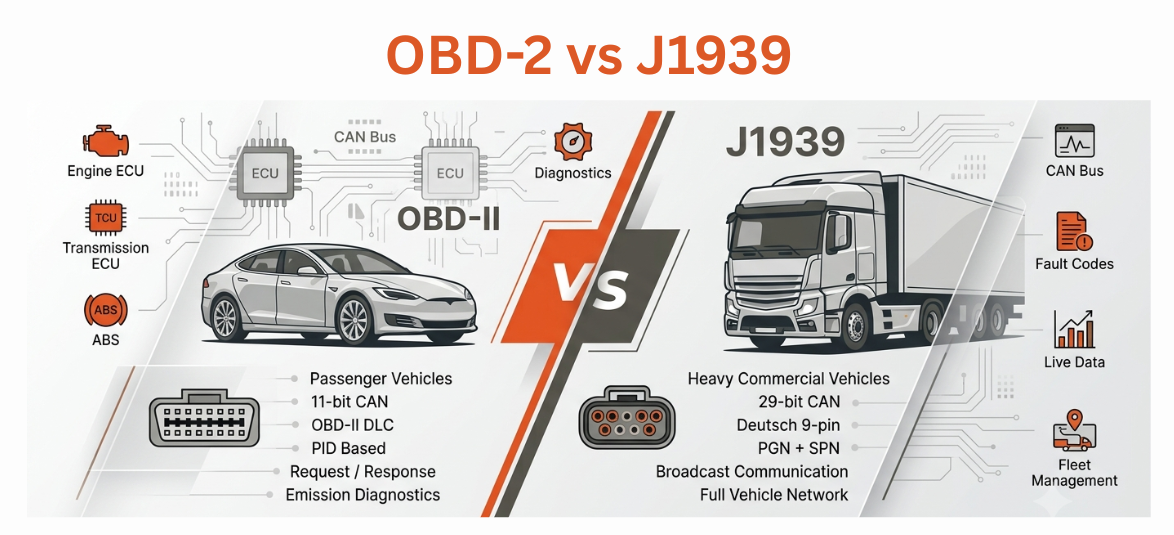
When it comes to OBD-II vs J1939, fleet managers, telematics engineers, and vehicle diagnostics professionals are often confused about which automotive diagnostic protocol applies to their vehicle, and why the same diagnostic tool cannot work across all vehicle types. The answer lies in fundamentally different design goals: the OBD2 standard was created for emissions compliance in passenger cars, while J1939 was built for comprehensive vehicle diagnostics and inter-ECU communication in heavy commercial vehicles. Understanding the structural differences between these two automotive diagnostic protocols clarifies which tools, connectors, and data formats apply to your application.
The OBD2 Standard: Passenger Car Diagnostics
The OBD2 standard (On-Board Diagnostics II) was mandated in the United States for all petrol passenger cars from 1996 onwards, and subsequently adopted across Europe, Australia, and most major markets. Its primary purpose was emissions compliance — regulators needed a standardised way for any scan tool to read vehicle diagnostics from any car without proprietary tools. The OBD2 standard achieves this through a mandatory 16-pin diagnostic link connector (DLC), standardised communication protocols (including ISO 15765-4 CAN at 500 kbit/s), and a universal set of Parameter IDs (PIDs) for common signals like engine speed, coolant temperature, and oxygen sensor readings.
The OBD2 standard uses 11-bit CAN identifiers and request-response messaging — a diagnostic tool sends a service request (Mode $01 for live data, Mode $03 for ECU fault codes) and the vehicle ECU responds. This standardised automotive diagnostic protocol means any OBD2 scanner can read basic vehicle diagnostics from any compliant car without vehicle-specific software. ECU fault codes in the OBD2 standard follow a P (powertrain), B (body), C (chassis), or U (network) format, making the source and category of the fault immediately identifiable.
J1939: Heavy Vehicle Diagnostics and ECU Communication
In OBD-II vs J1939, the heavy-duty side of the comparison is J1939 — a comprehensive automotive diagnostic protocol developed by SAE International specifically for trucks, buses, agricultural machinery, and construction equipment. Unlike the OBD2 standard's focus on emissions compliance, J1939 is a full vehicle network communication standard that defines not just vehicle diagnostics but also real-time parameter sharing between ECUs — engine, transmission, braking, and axle systems all communicate via J1939 simultaneously.
J1939 uses 29-bit CAN identifiers, providing a much larger address space than the OBD2 standard. Data is organised into Parameter Group Numbers (PGNs) — each PGN defines a packet of related parameters — and Suspect Parameter Numbers (SPNs) within each PGN define individual signals. ECU fault codes in J1939 are described by an SPN (identifying the faulty parameter) and a Failure Mode Identifier (FMI, identifying the type of fault). J1939 connects via a 9-pin Deutsch connector, quite different from the OBD2 standard's 16-pin DLC.
OBD-II vs J1939: Key Differences
| Feature | OBD2 Standard | J1939 |
|---|---|---|
| Target Vehicle | Passenger cars, light commercial | Heavy trucks, buses, agriculture, marine |
| CAN Identifier | 11-bit (standard CAN) | 29-bit (extended CAN) |
| Connector | 16-pin OBD-II DLC | 9-pin Deutsch (SAE J1939-13) |
| Data Structure | PIDs (Parameter IDs) | PGNs (Parameter Group Numbers) + SPNs |
| ECU Fault Codes | DTCs (P/B/C/U format) | SPN + FMI |
| Communication Mode | Request-response diagnostic | Broadcast + diagnostic request |
| Governing Body | SAE/ISO (OBD2 standard) | SAE International (J1939) |
When to Use Each Automotive Diagnostic Protocol
In the OBD-II vs J1939 decision, the vehicle type determines the answer. If you are working with passenger vehicles, SUVs, or light vans, the OBD2 standard applies — any compliant scan tool will read vehicle diagnostics and ECU fault codes. If you are working with heavy trucks (GVW above 3.5 tonnes), city buses, agricultural equipment, or marine engines, J1939 is the relevant automotive diagnostic protocol. Many fleet operators manage both passenger and heavy vehicles simultaneously, which requires telematics hardware capable of handling OBD-II vs J1939 traffic from mixed fleets without additional hardware per vehicle type.
Bridge OBD-II and J1939 Fleets with Precisol Automation
Managing vehicle diagnostics across a mixed fleet — combining passenger car OBD2 standard vehicles with heavy commercial J1939 trucks — demands hardware that speaks both automotive diagnostic protocols fluently. Precisol Automation's CAN Telematics Logger supports both J1939 PGN/SPN decoding and OBD2 standard PID access, capturing ECU fault codes and live vehicle diagnostics in a single, unified platform. The CAN Bus Gateway provides the protocol translation layer needed when OBD-II vs J1939 data must be forwarded to a common fleet management cloud application.
See how J1939-based vehicle diagnostics powers real fleet management in our heavy truck fleet management case study, or explore how Precisol tools enable haul truck fleet management with live ECU fault code monitoring.
Frequently Asked Questions
What is the main difference between OBD-II vs J1939?
In OBD-II vs J1939, the key difference is vehicle type and data structure. The OBD2 standard targets passenger cars with 11-bit CAN and PIDs. J1939 targets heavy commercial vehicles with 29-bit CAN, PGNs, and SPNs — and covers both ECU fault codes and real-time inter-ECU communication.
Can I use the same diagnostic tool for OBD-II and J1939 vehicles?
Not typically. OBD-II vs J1939 vehicles use different connectors, identifier lengths, and automotive diagnostic protocol structures. Purpose-built telematics hardware that supports both is available, but a generic OBD2 standard scanner will not read J1939 ECU fault codes from heavy trucks.
Does J1939 use the same ECU fault codes as OBD-II?
No. The OBD2 standard uses DTCs in P/B/C/U format. J1939 uses SPNs and FMIs for ECU fault codes. Both are automotive diagnostic protocols but the ECU fault code structures are completely different and not interchangeable.