Remote equipment monitoring with IoT technology provides continuous, automated visibility of industrial asset condition from anywhere — replacing periodic manual inspection rounds with real-time sensor data streams, cloud analytics, and proactive alerts. An IoT remote monitoring system connects field sensors on motors, pumps, compressors, boilers, tanks, and pipelines to a cloud platform via IIoT gateways, delivering an equipment health dashboard that shows every asset's real-time status, trend history, and alarm state to any authorised user on any device. Industrial remote monitoring via IoT is particularly transformative for operations teams managing distributed assets — water utilities with pump stations across a region, manufacturing companies with equipment at multiple plants, or energy companies with remote generation and distribution infrastructure. This guide covers the complete remote equipment monitoring technology stack: sensors, gateways, connectivity, cloud platforms, and alert configuration.
The Remote Equipment Monitoring Technology Stack
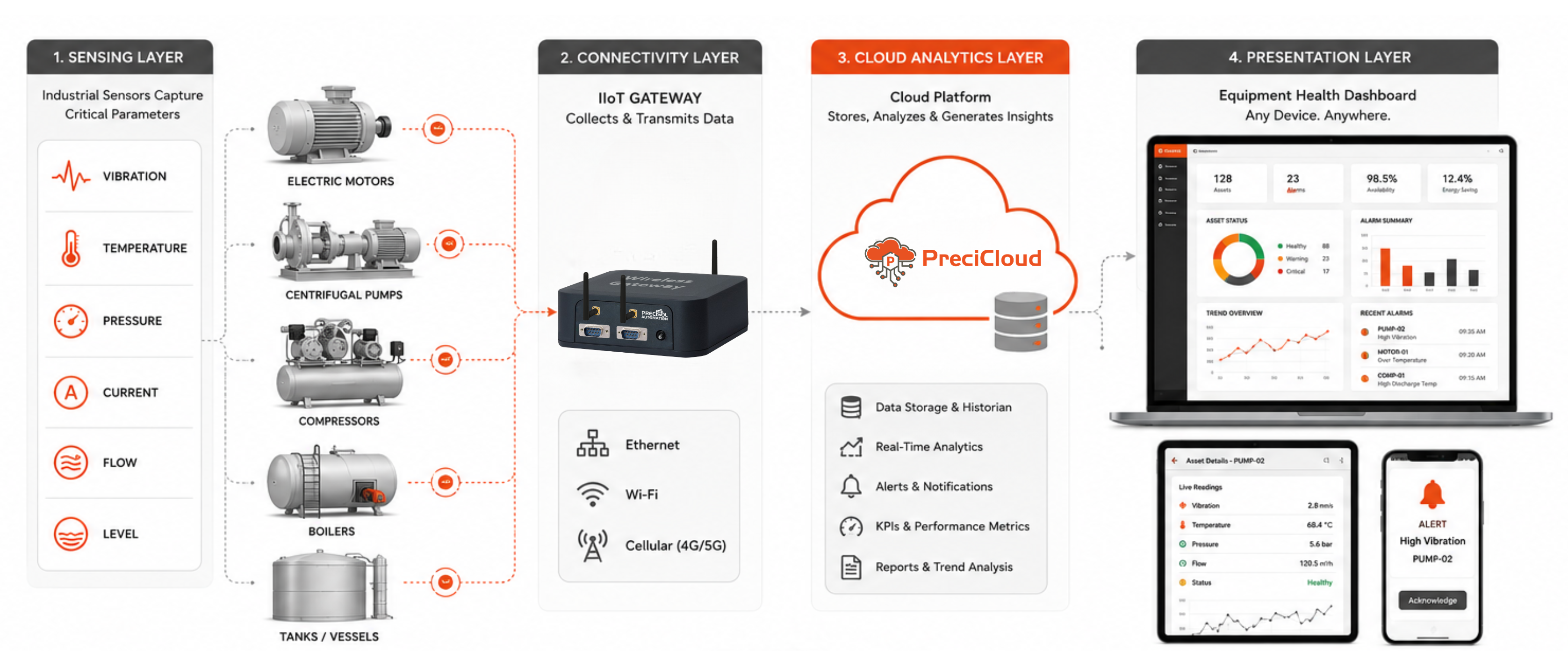
A complete IoT remote monitoring solution for industrial assets has four functional layers, each making a distinct contribution to industrial remote monitoring capability:
- Sensing Layer: Physical sensors on the equipment — vibration, temperature, current, pressure, flow, and level — generate the raw data that makes remote equipment monitoring possible. Sensor selection is determined by the failure modes being monitored and the measurement accuracy required for reliable industrial remote monitoring alerting.
- Connectivity Layer: IIoT gateways collect sensor data (via RS485 Modbus, 4–20 mA analog inputs, or digital inputs) and transmit it to the cloud via Ethernet, Wi-Fi, or cellular. The gateway is the critical link that makes IoT remote monitoring possible at sites without existing data network infrastructure.
- Cloud Analytics Layer: The cloud platform stores historical data, runs threshold-based alerts, calculates KPIs (availability, efficiency, energy consumption), and provides trend analysis. This is the intelligence layer of remote equipment monitoring — converting raw sensor readings into actionable maintenance intelligence.
- Presentation Layer: The equipment health dashboard presents real-time readings, alarm status, historical trends, and maintenance records in a format accessible to operators, maintenance technicians, and management. Mobile access to the equipment health dashboard allows field teams to check asset status on their phone during any rounds or response activities.
Selecting Sensors for Industrial Remote Monitoring
| Asset Type | Priority Sensors for Remote Equipment Monitoring | Failure Modes Detected |
|---|---|---|
| Electric Motors | Vibration, winding temperature, current (3-phase) | Bearing failure, overheating, overloading, phase imbalance |
| Centrifugal Pumps | Vibration, suction/discharge pressure, bearing temperature | Cavitation, bearing wear, seal failure, efficiency loss |
| Compressors | Vibration, discharge pressure/temperature, inlet filter dP | Bearing/valve failure, fouled inlet filter, overheating |
| Boilers | Steam pressure, drum level, stack temperature, flue gas O₂ | Overpressure, low water, combustion efficiency degradation |
| Remote Tanks/Vessels | Level, temperature, pressure | Overflow, underfill, temperature exceedance in IoT remote monitoring |
Remote SCADA vs IoT Remote Monitoring: Choosing the Right Architecture
Operations teams migrating from traditional remote SCADA to modern IoT remote monitoring often ask how these architectures compare. Remote SCADA provides deterministic, low-latency control and monitoring on a closed network — it remains the right choice for time-critical process control. For industrial remote monitoring of equipment health (predictive maintenance, condition monitoring, energy management), IoT remote monitoring offers compelling advantages: lower infrastructure cost, cloud-based scalability, browser-based equipment health dashboard without VPN, and easy integration with IT analytics platforms. Many industrial sites run both — remote SCADA for real-time process control, IoT remote monitoring for equipment health and predictive maintenance visibility — with the IIoT gateway reading from the same sensor bus as the remote SCADA system without interfering with it.
Deploy Remote Equipment Monitoring with Precisol Automation
Precisol Automation's PreciView IoT Monitoring Application provides the equipment health dashboard layer of a complete remote equipment monitoring solution — real-time readings, historical trending, alarm management, and mobile access. The Serial IIoT Gateway provides the field connectivity: collecting RS485 Modbus sensor data and transmitting it to PreciView for industrial remote monitoring of motors, pumps, boilers, and process equipment at any site, anywhere.
See IoT remote monitoring transforming operations at a water treatment facility in our water treatment plant remote monitoring case study, or explore how Precisol enables remote monitoring and control for Modbus PLCs as part of a complete remote equipment monitoring solution.
Frequently Asked Questions
What is remote equipment monitoring with IoT?
Remote equipment monitoring with IoT is automated, continuous collection and cloud transmission of equipment sensor data — vibration, temperature, pressure, current — displayed on an equipment health dashboard accessible from anywhere. IoT remote monitoring eliminates manual inspection rounds and provides 24/7 industrial remote monitoring visibility of asset health.
What sensors are used in remote equipment monitoring?
IoT remote monitoring uses vibration accelerometers, temperature sensors, current transformers, pressure transmitters, flow meters, and level sensors depending on the asset type. An equipment health dashboard aggregates all streams into a unified industrial remote monitoring view, with alerts configured per sensor and asset.
How is IoT remote monitoring different from SCADA?
Remote SCADA is an on-premise, closed control system for real-time process control. IoT remote monitoring uses cloud architecture — gateways publish to cloud platforms accessible from any device without VPN. For industrial remote monitoring of equipment health and predictive maintenance, IoT remote monitoring is lower cost and more scalable than traditional remote SCADA, with an equipment health dashboard accessible to all stakeholders simultaneously.