Predictive Maintenance vs Preventive Maintenance: Which Strategy Wins?
20 July 2026
Predictive maintenance and preventive maintenance are the two dominant strategies for keeping industrial plant assets reliable — but they work very differently and deliver very different results. Predictive maintenance uses real-time sensor data and condition-based maintenance rules to identify developing faults before they cause failures, enabling intervention only when equipment actually needs it. Preventive maintenance schedules service at fixed time or usage intervals regardless of the machine's actual condition. The shift from preventive to predictive maintenance is one of the most impactful levers available to operations teams — reducing both unnecessary maintenance costs and unplanned downtime while improving equipment reliability across the plant. This guide compares both strategies on cost, downtime, data requirements, and ROI, and explains where a maintenance strategy IoT investment makes business sense.
What Is Preventive Maintenance?
Preventive maintenance is time-triggered or usage-triggered servicing of equipment based on a predetermined schedule. An electric motor receives new bearings every 8,000 operating hours; a compressor receives an oil change every 6 months; a conveyor belt is inspected and tensioned every quarter. Preventive maintenance eliminates the run-to-failure approach by ensuring regular attention — but it makes a critical assumption: that the service interval matches the failure rate of every individual machine in the fleet. In practice, preventive maintenance replaces components that still have significant service life remaining in some machines, while failing to catch accelerated wear in others. Equipment reliability under a pure preventive maintenance regime is a function of how well the schedule matches actual degradation rates — which varies widely across nominally identical assets operating in different conditions.
What Is Predictive Maintenance?
Predictive maintenance (PdM) is condition-based maintenance — service is triggered by the actual condition of the equipment, not by a calendar. Sensors monitor the machine continuously (vibration accelerometers, temperature sensors, current transformers, pressure transducers), and a maintenance strategy IoT platform analyses that data to detect the signatures of developing faults. When a bearing begins to spall, vibration at the bearing defect frequency increases days or weeks before failure — predictive maintenance catches this change and triggers a work order while there is still time to plan a scheduled shutdown. When an impeller begins to cavitate, pressure fluctuations and vibration change in characteristic ways — condition-based maintenance rules detect the pattern and alert the maintenance team before the pump is damaged. Predictive maintenance converts unplanned emergency stoppages into planned interventions, protecting equipment reliability and production continuity.
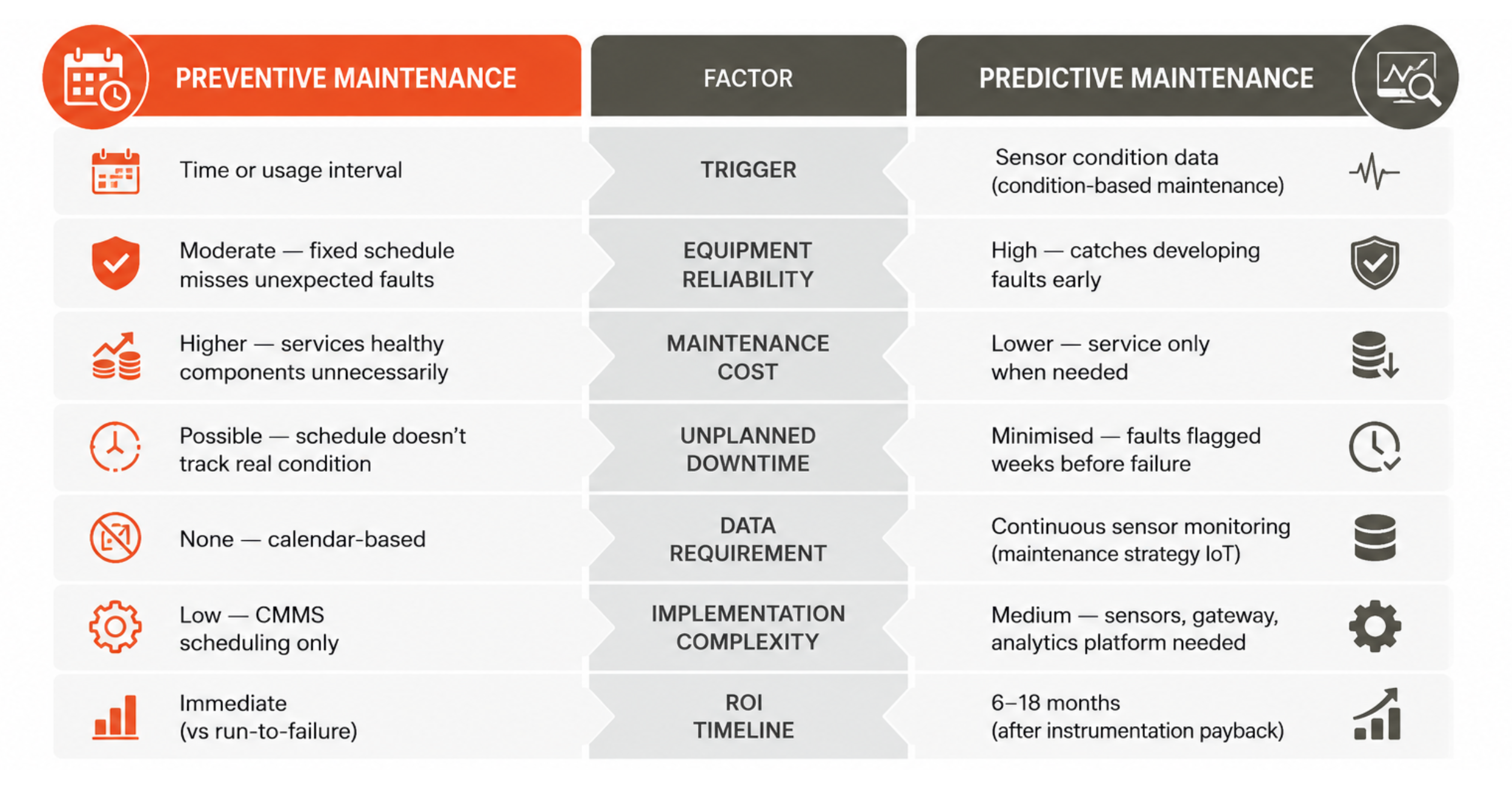
Predictive Maintenance vs Preventive Maintenance: Head-to-Head Comparison
| Factor | Preventive Maintenance | Predictive Maintenance |
|---|---|---|
| Trigger | Time or usage interval | Sensor condition data (condition-based maintenance) |
| Equipment Reliability | Moderate — fixed schedule misses unexpected faults | High — catches developing faults early |
| Maintenance Cost | Higher — services healthy components unnecessarily | Lower — service only when needed |
| Unplanned Downtime | Possible — schedule doesn't track real condition | Minimised — faults flagged weeks before failure |
| Data Requirement | None — calendar-based | Continuous sensor monitoring (maintenance strategy IoT) |
| Implementation Complexity | Low — CMMS scheduling only | Medium — sensors, gateway, analytics platform needed |
| ROI Timeline | Immediate (vs run-to-failure) | 6–18 months (after instrumentation payback) |
Where Predictive Maintenance Delivers the Best ROI
Predictive maintenance returns the highest value on assets where unplanned failure is expensive, failure modes produce detectable sensor signatures, and continuous operation is critical to production. High-value rotating equipment — motors above 30 kW, large centrifugal pumps, compressors, fans, gearboxes — tops the list. Condition-based maintenance on these assets typically reduces maintenance costs by 20–30% compared to preventive maintenance, while cutting unplanned downtime by 50–70%. Equipment reliability improvements of this magnitude translate directly to production output and plant availability. A maintenance strategy IoT investment that monitors 10 critical machines and prevents even two unplanned failures per year typically pays back within 12 months in most industrial sectors.
Build Predictive Maintenance Capability with Precisol Automation
Implementing predictive maintenance requires three infrastructure elements: sensors on the assets, a connectivity gateway to aggregate and transmit sensor data, and a monitoring platform for condition-based maintenance alerting and trending. Precisol Automation's Serial IIoT Gateway connects RS485-communicating sensors and PLCs to the cloud, forming the connectivity backbone of any maintenance strategy IoT deployment. The PreciView IoT Monitoring Application provides the dashboard, threshold alerting, and historical trending needed to operationalise predictive maintenance rules and track equipment reliability improvement over time.
See predictive maintenance driving measurable uptime improvement in our predictive maintenance in carbon manufacturing case study, or explore how Precisol supports proactive maintenance of construction equipment with condition-based monitoring.
Frequently Asked Questions
What is the difference between predictive maintenance and preventive maintenance?
Preventive maintenance is time-based — service at fixed intervals regardless of condition. Predictive maintenance is condition-based maintenance triggered by real sensor data showing actual equipment degradation. Predictive maintenance improves equipment reliability and reduces unnecessary service costs compared to fixed-schedule preventive maintenance.
What data does predictive maintenance require?
Predictive maintenance requires continuous sensor data — vibration, temperature, current, and pressure depending on the asset type. A maintenance strategy IoT system collects this data via an IIoT gateway and analyses it with condition-based maintenance rules to generate early fault alerts, often days or weeks before failure would occur.
When is preventive maintenance better than predictive maintenance?
Preventive maintenance is better for low-cost, easily replaced components with time-correlated failure modes (belts, filters, seals). When maintenance strategy IoT instrumentation costs exceed the savings from optimised intervals, preventive maintenance wins. For high-value rotating machinery, predictive maintenance delivers superior equipment reliability and ROI.