RS485 IO Controller: Flexible Industrial Digital IO and Remote Monitoring
17 July 2026
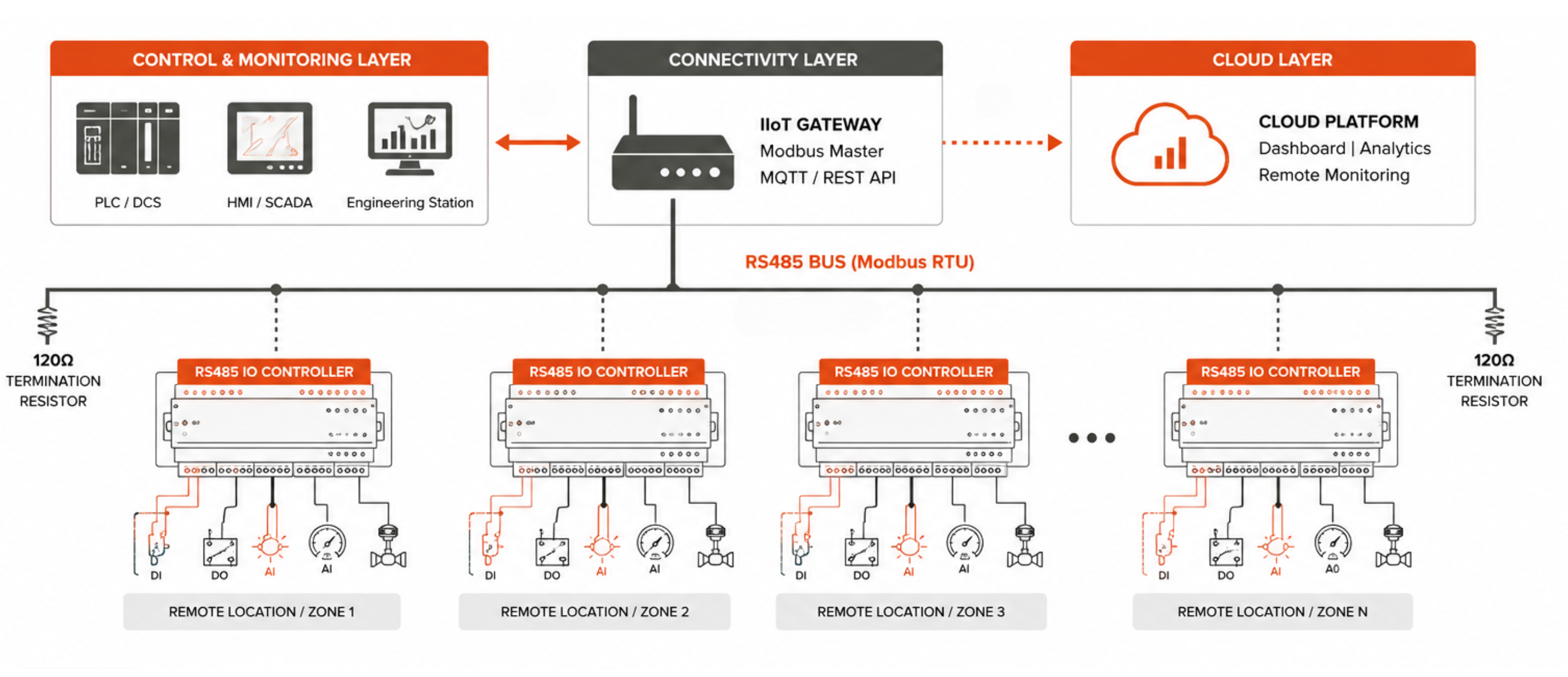
An RS485 IO controller is a compact remote IO module that extends the physical input/output capability of a PLC or supervisory system across large plant areas, using RS485 serial communication and the Modbus RTU protocol. Each RS485 IO controller on the RS485 bus provides industrial digital IO — digital inputs for switch, proximity sensor, and alarm detection; digital outputs for relay, contactor, and valve control — alongside optional RS485 analog input channels for current and voltage signal monitoring. By deploying multiple remote IO module nodes across a facility, engineers build a distributed IO system that dramatically reduces wiring costs compared to running every field signal back to a centralised control panel. The RS485 IO controller architecture is particularly powerful in large plants, warehouses, pipeline installations, and multi-building facilities where central IO would require hundreds of metres of individual signal cables.
The Case for a Distributed IO System with RS485
Traditional PLC architectures wire every field device — every sensor, every switch, every valve — back to the central control panel over individual copper conductors. In a large facility, this can mean thousands of wire runs of 50, 100, or 200 metres each. A distributed IO system using RS485 IO controllers changes this architecture fundamentally: instead of wiring individual signals back to the centre, a single two-wire RS485 cable runs throughout the plant, and RS485 IO controllers at each local cluster of field devices collect and transmit that IO data digitally. The centralised PLC polls each remote IO module over the RS485 bus and reads all industrial digital IO points, analog inputs, and status registers as Modbus registers — the same engineering interface, but with dramatically reduced wiring infrastructure.
For a facility with 200 field signals distributed across 10 locations, a distributed IO system with RS485 IO controllers at each location may require just 200 metres of RS485 cable instead of 2,000+ metres of individual signal wire — a 90% reduction in cabling cost and installation time.
RS485 IO Controller Architecture and IO Types
A typical RS485 IO controller provides a configurable mix of:
- Digital Inputs (DI): Industrial digital IO inputs accept 24V DC signals from proximity switches, push buttons, position sensors, and dry-contact alarm contacts. The RS485 IO controller reads each DI channel and maps its state (0 or 1) to a Modbus coil or discrete input register accessible by the master PLC via the distributed IO system bus.
- Digital Outputs (DO): Industrial digital IO relay or transistor outputs drive contactors, solenoid valves, signal lights, and small actuators. The remote IO module allows the PLC to set each DO channel by writing to the corresponding Modbus coil over the RS485 IO controller bus.
- RS485 Analog Inputs (AI): RS485 analog input channels accept 4–20 mA current loop signals from pressure, temperature, flow, and level transmitters. The RS485 IO controller digitises the analog signal and maps the value to a Modbus input register, making it available to the distributed IO system master as a 16-bit integer with configurable scaling.
- Analog Outputs (AO): Some RS485 IO controller models provide 4–20 mA or 0–10V analog outputs for controlling variable-speed drives, control valves, and other analog-actuated field devices from the remote IO module.
Wiring and Topology for Distributed IO Systems
| Parameter | RS485 IO Controller / Distributed IO System Specification |
|---|---|
| Bus Topology | Daisy-chain or star (with hub); daisy-chain preferred for industrial digital IO distributed IO systems |
| Max Cable Length | 1,200 m at 9,600 baud; 300 m at 115,200 baud for RS485 IO controller networks |
| Cable Type | Twisted pair (120Ω characteristic impedance) for RS485 analog input accuracy |
| Termination | 120Ω resistor at each end of the RS485 IO controller bus |
| Max Nodes | 32 unit loads standard; 128 with high-impedance RS485 IO controller transceivers; repeaters add segments |
| Baud Rate | 9,600–115,200 baud — match across all remote IO module nodes; lower baud for longer distributed IO system runs |
Integrating RS485 IO Controllers into Cloud Monitoring
A standalone RS485 IO controller distributed IO system communicates only with the local PLC master. To connect that industrial digital IO data to cloud dashboards, remote monitoring portals, or SCADA systems over IP networks, an IIoT gateway is added to the RS485 bus as a Modbus master. The gateway polls all RS485 IO controllers on the distributed IO system bus, reads digital input states and RS485 analog input values, and forwards them to a cloud platform via MQTT or REST API. This three-tier architecture — RS485 IO controller → RS485 bus → IIoT gateway → cloud — is the standard pattern for building cloud-connected distributed IO systems from existing or new RS485 remote IO module infrastructure.
Deploy Precisol's RS485 IO Controllers for Your Plant
Precisol Automation's Serial RS485 IO Controller provides a robust, configurable remote IO module with industrial digital IO channels (DI/DO) and RS485 analog input — communicating over Modbus RTU on the RS485 bus for seamless distributed IO system integration. For expanded IO capacity and direct cloud connectivity, the IO Module provides additional channel density within the same Modbus RTU RS485 IO controller architecture.
See distributed IO system deployment monitoring physical pipeline signals in our industrial pipeline monitoring case study, or explore how Precisol enables remote digital IO monitoring using RS485 IO controller cloud integration.
Frequently Asked Questions
What is an RS485 IO controller used for in industrial systems?
An RS485 IO controller is a remote IO module that extends industrial digital IO and RS485 analog input capability across a plant via Modbus RTU over RS485. It is a distributed IO system node that eliminates long individual wire runs — the PLC polls each RS485 IO controller over a single RS485 cable pair to read all field signals digitally.
How many RS485 IO controllers can be connected on a single RS485 bus?
A standard RS485 bus supports 32 unit loads (remote IO module nodes), expandable to 128 with high-impedance RS485 IO controller transceivers. RS485 repeaters extend the distributed IO system by adding additional bus segments, each supporting another 32 nodes at distances up to 1,200 m per segment.
Can an RS485 IO controller handle both digital and analog signals?
Yes. An RS485 IO controller combines industrial digital IO (24V DI/DO channels) with RS485 analog input (4–20 mA) in a single remote IO module. This enables the distributed IO system to monitor sensors, control actuators, and read transmitters — all via Modbus RTU on one RS485 cable pair.