Water Treatment Plant IoT Monitoring: Quality, Compliance, and Efficiency
23 September 2026
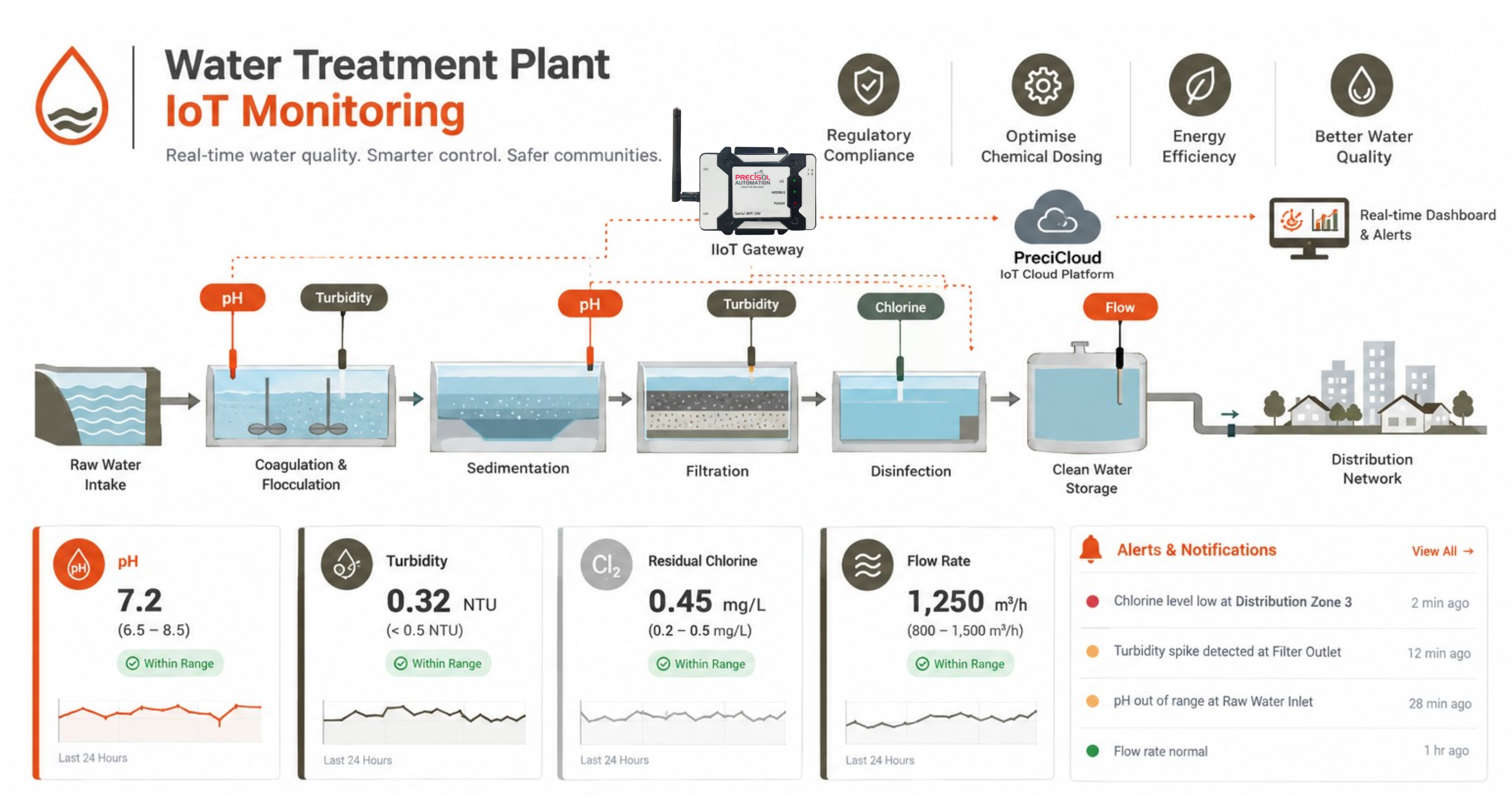
Water treatment plant IoT monitoring provides the continuous, multi-parameter water quality data that drinking water utilities, industrial water treatment facilities, and wastewater treatment plants need to ensure regulatory compliance, optimise chemical dosing, and achieve energy efficiency targets across increasingly complex treatment processes. Water treatment is fundamentally a data-intensive operation: raw water quality changes continuously with rainfall, seasonal variation, and upstream events; the treatment process must respond to these changes in real time to maintain treated water quality within regulatory limits for pH, turbidity, residual chlorine, and multiple other parameters. Without continuous water quality monitoring IoT, operators rely on periodic manual sampling — a process that detects problems after they have persisted for hours, long after non-compliant water may have entered the distribution network. Water treatment plant IoT monitoring with online analysers and IoT gateways closes this gap: pH sensors, turbidimeters, chlorine analysers, and flow meters report measurements every second to a cloud platform that monitors every parameter against its limit simultaneously, alerting operators the instant any value deviates from specification. Smart water management builds on this data foundation to close the loop between monitoring and control — automatically adjusting coagulant dosing based on raw water turbidity, modulating chlorine feed based on residual measurement, and scheduling pump operation against electricity tariff periods for energy cost reduction. pH monitoring IoT and turbidity monitoring water quality instruments are the cornerstone sensors of any water treatment plant IoT monitoring deployment.
Key Parameters in Water Treatment Plant IoT Monitoring
- pH Monitoring IoT: pH is the central control variable for multiple treatment stages — coagulation and flocculation are pH-sensitive (optimal coagulation typically between pH 6.5–7.5); chlorination effectiveness depends on pH (hypochlorous acid formation is favoured below pH 7.5); and distribution network corrosion control requires pH above 7.0 to protect pipe infrastructure. Continuous pH monitoring IoT at raw water, post-coagulation, post-filtration, and distribution entry points enables real-time pH correction and chemical dose optimisation.
- Turbidity Monitoring Water Quality: Turbidity (measured in NTU) indicates the concentration of suspended particles in water — a proxy for pathogen removal effectiveness in filtration and an indicator of coagulation and settling performance. Regulatory limits (typically <0.5 NTU for filtered water) require continuous turbidity monitoring water quality measurement at filter outlet and distribution entry — spikes indicate filter breakthrough or coagulation failure requiring immediate operator response. Water treatment plant IoT monitoring turbidimeters continuously monitor and log NTU values for compliance records.
- Residual Chlorine Monitoring: Free residual chlorine in the distribution network (typically 0.2–0.5 mg/L) ensures microbiological safety through the pipe network. Online chlorine analysers connected to water quality monitoring IoT gateways monitor chlorine at treatment outlet and at key distribution zone points — enabling chlorine booster dosing where residuals decay below the minimum regulatory requirement before reaching consumers.
- Flow Rate and NRW Monitoring: Flow measurement at treatment plant output and at distribution zone inlets enables smart water management water balance analysis — comparing water produced against water metered to consumers to quantify non-revenue water (NRW) losses from pipe leaks. Water treatment plant IoT monitoring flow data integrated with smart meter consumption data enables zone-level water balance calculations that identify where leak volumes are highest for targeted infrastructure repair.
Water Treatment Plant IoT Monitoring: Parameter Reference
| Parameter | IoT Sensor Type | Regulatory/Process Significance |
|---|---|---|
| pH | pH monitoring IoT — glass electrode or solid-state sensor | BIS/WHO limit 6.5–8.5; coagulation and disinfection process control |
| Turbidity | Turbidity monitoring water — nephelometric sensor (NTU) | BIS <1 NTU (treated); filter breakthrough detection; WHO <0.5 NTU |
| Residual Chlorine | Amperometric online chlorine analyser | Distribution minimum 0.2 mg/L; maximum 5 mg/L regulatory limit |
| Flow Rate | Electromagnetic or ultrasonic flow meter — water quality monitoring IoT | Water balance; NRW calculation; energy efficiency per m³ treated |
| Dissolved Oxygen | Optical DO sensor | Biological treatment process control (activated sludge, SBR) |
Deploy Water Treatment Plant IoT Monitoring with Precisol Automation
Precisol Automation's Serial IIoT Gateway connects to Modbus RTU/TCP water quality analysers, flow meters, and level sensors across treatment plant stages — aggregating all water treatment plant IoT monitoring data for cloud transmission. The PreciCloud IoT Cloud Dashboard provides the smart water management platform with real-time parameter dashboards, compliance alert management, pH monitoring IoT and turbidity monitoring water trend charts, and regulatory data export for CPCB and BIS compliance reporting.
See industrial process monitoring with IIoT integration in our IT-OT bridge for process automation case study, or explore water quality monitoring using the Serial IIoT Gateway for implementation details on water quality monitoring IoT for treatment plant compliance.
Frequently Asked Questions
What parameters does water treatment plant IoT monitoring measure?
Water treatment plant IoT monitoring measures pH (via pH monitoring IoT sensors), turbidity (turbidity monitoring water quality in NTU), residual chlorine, dissolved oxygen, conductivity, flow rate, pressure, and temperature. Smart water management platforms aggregate these water quality monitoring IoT parameters with chemical dosing data, pump energy, and reservoir levels — providing operators a complete real-time process view for compliance management and operational efficiency.
How does IoT improve water quality monitoring for regulatory compliance?
Water quality monitoring IoT replaces periodic manual sampling with continuous online measurement — detecting pH monitoring IoT and turbidity monitoring water exceedances immediately rather than hours later. Automated alerts trigger real-time operator response; digital compliance records provide audit-ready continuous data logs that prove parameter values for every minute, eliminating the gaps and errors of paper log books. Water treatment plant IoT monitoring reduces exceedance duration from hours to minutes.
What is smart water management and how does IoT enable it?
Smart water management uses water treatment plant IoT monitoring data to optimise treatment for quality, energy efficiency, and chemical cost simultaneously. Flow, water quality monitoring IoT parameters, and chemical dosing data feed analytics that optimise coagulant and chlorine dosing automatically against real-time raw water quality. Smart water management also enables non-revenue water reduction via distribution pressure monitoring — comparing flow to zone consumption to identify leaks for targeted infrastructure repair.