Remote Terminal Unit (RTU) and SCADA: How IIoT Modernises Legacy Infrastructure
21 September 2026
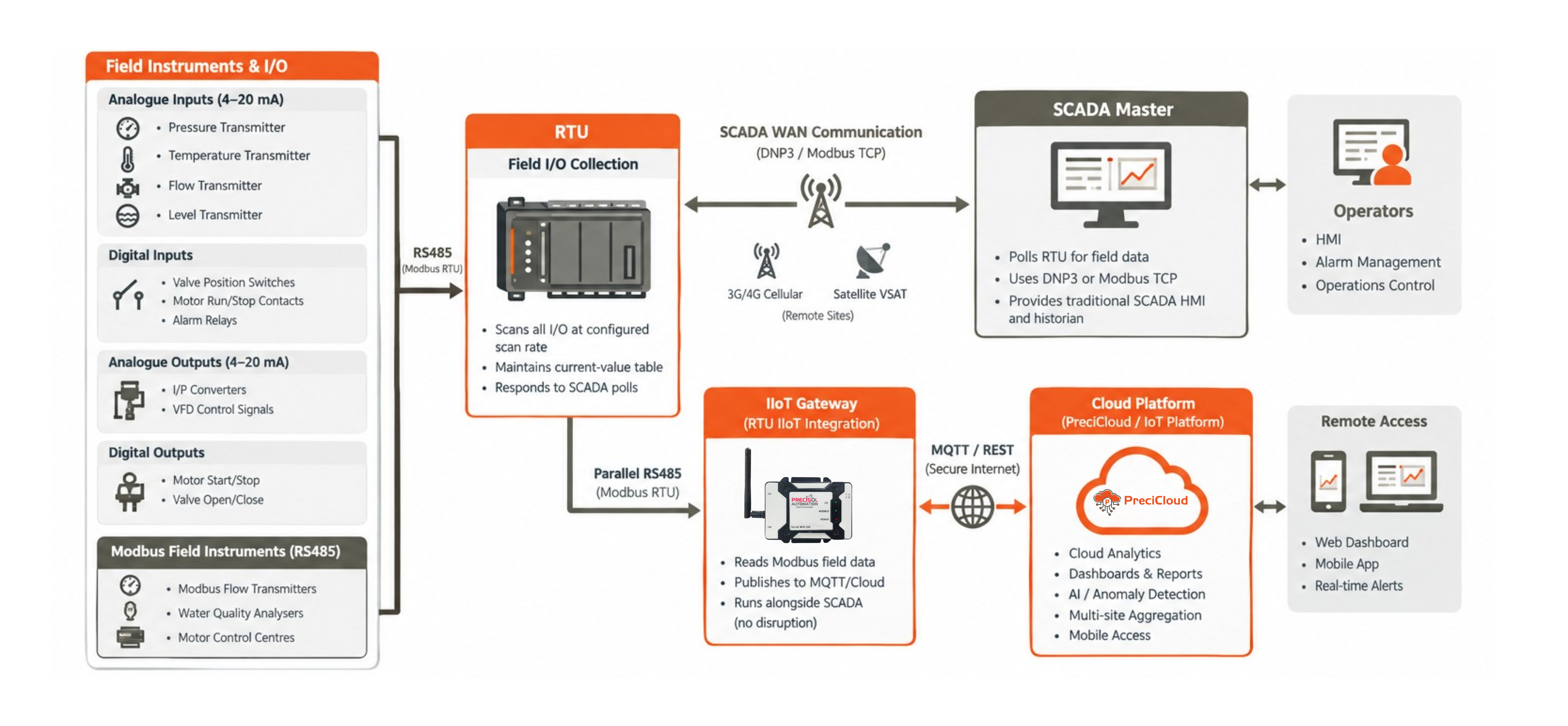
The remote terminal unit SCADA architecture — RTUs at remote field sites communicating field instrument data to a central SCADA master — has been the operational backbone of oil and gas pipelines, water utilities, power transmission systems, and remote industrial infrastructure for four decades. RTUs are not legacy curiosities to be retired; they are deeply embedded, proven assets managing billions of dollars of critical infrastructure with high reliability in harsh environments and remote locations. The challenge is that the traditional remote terminal unit SCADA architecture was designed for an era before cloud analytics, mobile access, AI-based anomaly detection, and multi-site operational intelligence — capabilities that modern operations teams need, but which point-to-point SCADA polling architectures cannot deliver without fundamental change. RTU IIoT integration solves this by adding a cloud data path to existing RTU and SCADA infrastructure — using IIoT gateways that speak RTU Modbus protocol to collect the same field data the SCADA system polls, and simultaneously publish it to cloud platforms for analytics, dashboarding, and alarm management that the SCADA system cannot provide. This SCADA modernisation IoT approach preserves the existing SCADA investment and operational continuity while unlocking the modern data capabilities that competitive operations now require. Understanding how remote terminal unit SCADA works — and how RTU IIoT integration extends it — is essential for engineers planning infrastructure upgrades in utilities, oil and gas, and remote industrial operations.
Remote Terminal Unit SCADA: Architecture and Communication
- RTU Field I/O: The remote terminal unit SCADA field interface layer — analogue inputs (4–20 mA from pressure, temperature, flow, and level transmitters), digital inputs (contact states from valve position switches, motor run/stop contacts, alarm relays), analogue outputs (4–20 mA control signals to I/P converters or VFDs), and digital outputs (relay outputs for motor start/stop, valve open/close commands). The RTU scans all I/O at its configured scan rate and maintains a current-value table that the SCADA master reads on poll.
- RTU Modbus Protocol Communication: At the instrument level, RTU Modbus protocol (Modbus RTU over RS485) enables the RTU to communicate with smart field instruments — Modbus flow transmitters, multi-parameter water quality analysers, and motor control centres expose Modbus registers that the RTU can read alongside its hardwired analogue and digital I/O. This extends the RTU's data collection reach beyond wired I/O to networked instruments on site.
- SCADA WAN Communication: The RTU communicates to the central SCADA master over wide-area links — historically serial radio or leased line, now primarily 3G/4G cellular or satellite VSAT for remote sites. The SCADA master uses DNP3 or Modbus TCP as the polling protocol over these WAN links, with the RTU responding to each poll request with current field data.
- SCADA Modernisation IoT — Parallel Cloud Path: RTU IIoT integration adds a second communication path: an IIoT gateway mounted at the RTU site reads the same Modbus field data via a parallel RS485 connection to field instruments, and simultaneously publishes to MQTT/cloud — providing real-time data to cloud analytics platforms without touching the existing SCADA communication chain.
RTU vs IIoT Gateway: Comparison for SCADA Modernisation IoT
| Aspect | Traditional Remote Terminal Unit SCADA | RTU IIoT Integration Add-On Gateway |
|---|---|---|
| Primary Function | Field I/O collection for SCADA polling | Parallel cloud data publishing alongside SCADA |
| Protocol | RTU Modbus protocol; DNP3 to SCADA master | Modbus RTU/TCP input; MQTT/REST output to cloud |
| Connectivity | Serial radio, leased line, cellular to SCADA master | 4G LTE, Ethernet to cloud MQTT broker or IoT platform |
| Analytics | None — SCADA historian only | SCADA modernisation IoT — cloud AI, mobile dashboards, multi-site aggregation |
| Deployment Risk | Full SCADA replacement: high cost and disruption | RTU IIoT integration: non-invasive addition, zero SCADA disruption |
RTU IIoT Integration for Modern Utility Operations
In water utilities, remote terminal unit SCADA systems manage pump stations, reservoirs, and treatment plants across geographically distributed sites — ideal for RTU IIoT integration that adds cloud dashboards visible on operator smartphones, automated anomaly detection (pressure loss indicating pipe burst), and energy optimisation analytics (pump scheduling against tariff periods). In oil and gas pipelines, SCADA modernisation IoT via RTU IIoT integration adds real-time pipeline integrity analytics, predictive maintenance for compressor and pump stations, and regulatory compliance reporting that the SCADA system alone cannot generate efficiently. The RTU Modbus protocol compatibility of IIoT gateways with the existing field instrument network is the key enabler — the same Modbus instruments the SCADA polls are also read by the IIoT gateway for cloud publication, with no new field cabling or instrument changes required.
Deploy RTU IIoT Integration with Precisol Automation
Precisol Automation's Serial IIoT Gateway provides the RTU IIoT integration interface — reading field instruments over Modbus RTU (RS485/RS232) using the same RTU Modbus protocol as the SCADA system, and publishing data to cloud MQTT brokers for SCADA modernisation IoT analytics alongside the existing SCADA infrastructure. The PreciCloud IoT Cloud Dashboard provides the cloud-side remote terminal unit SCADA data visualisation, multi-site aggregation, and mobile access that traditional SCADA architectures cannot deliver.
See IT-OT connectivity enabling operational data integration in our IT-OT bridge for process automation case study, or explore remote monitoring for Modbus PLCs and RTUs as the technical foundation for RTU IIoT integration across utility and infrastructure networks.
Frequently Asked Questions
What is a Remote Terminal Unit (RTU) and how does it work with SCADA?
A remote terminal unit SCADA interface collects field instrument data (4–20 mA analogue inputs, digital contact inputs) and communicates it to a central SCADA master over wide-area links via DNP3 or Modbus TCP. The SCADA master polls each RTU at its scan rate; the RTU responds with current field values. RTU Modbus protocol (Modbus RTU over RS485) connects the RTU to smart field instruments at the site level, extending data collection beyond hardwired I/O.
How does RTU IIoT integration differ from traditional SCADA RTU communication?
Traditional remote terminal unit SCADA uses point-to-point polling to a single SCADA master. RTU IIoT integration adds a parallel cloud data path — an IIoT gateway reads the same RTU Modbus protocol field data and publishes to cloud MQTT brokers alongside the existing SCADA system, without disrupting it. SCADA modernisation IoT via this approach adds cloud analytics, mobile dashboards, and multi-site aggregation to mature infrastructure without the cost and risk of full SCADA replacement.
What is the RTU Modbus protocol and how is it used?
RTU Modbus protocol (Modbus RTU) is a binary serial communication protocol over RS485, used by remote terminal units to communicate with field instruments. Function codes 03/04 read analogue measurement registers; 05/06 write control outputs. RTU IIoT integration gateways that support Modbus RTU can read the same instrument registers as the SCADA RTU — collecting field data for SCADA modernisation IoT cloud publishing without requiring new instruments or field wiring.