Tank Level Monitoring with IoT: Remote Level Tracking and Inventory Management
22 September 2026
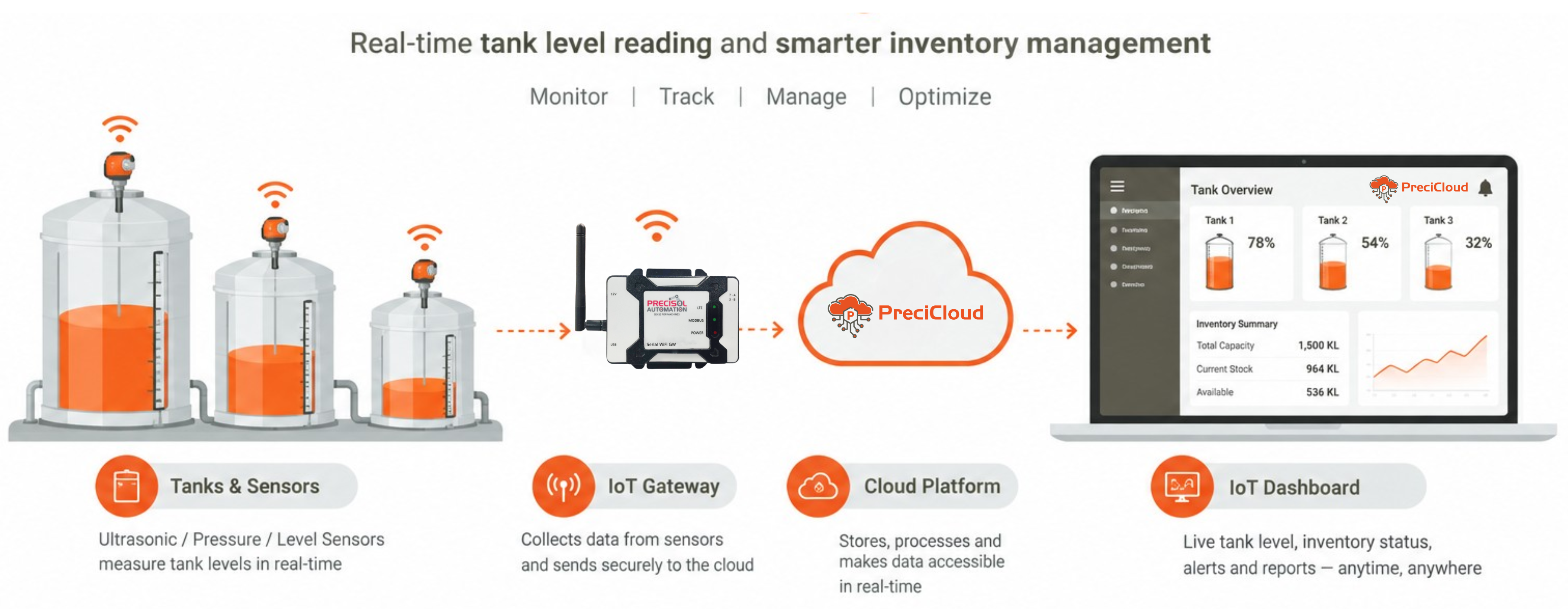
Tank level monitoring IoT provides real-time visibility of liquid levels, volumes, and consumption rates across storage tanks, process vessels, and remote fuel or chemical tanks — replacing periodic manual dip measurements and float alarm switches with continuous data that enables proactive inventory management, leak detection, and logistics optimisation. In industrial operations, tanks are ubiquitous: fuel storage tanks for generators and vehicles, process chemical storage for manufacturing, water storage reservoirs, effluent holding tanks, and product storage vessels — each representing inventory that must be managed to prevent production stoppages, environmental incidents, or supply chain failures. Remote tank level monitoring via cellular IIoT gateways solves the geographical challenge of distributed tank networks: a logistics company might have 200 fuel tanks at depots and remote sites across a country — tank level monitoring IoT with cellular connectivity gives the fuel management team a single dashboard showing all 200 tanks' current levels, consumption trends, and estimated days to reorder threshold. Liquid level sensor IoT technology has matured to the point where ultrasonic, radar, and hydrostatic pressure sensors can be installed on almost any tank and connected to wireless transmitters or cellular gateways with minimal site infrastructure — making tank inventory management IoT economically viable even for smaller distributed tank networks that previously could not justify SCADA-connected monitoring. The result is the elimination of both emergency runout events and unnecessary manual inspection visits across the entire monitored fleet.
Liquid Level Sensor IoT Technologies for Tank Level Monitoring
- Ultrasonic Level Sensor IoT: Non-contact measurement from the top of the tank — the ultrasonic level sensor IoT emits a sound pulse and measures the echo return time from the liquid surface to calculate distance and thus level. No contact with the liquid, no moving parts, and no material compatibility concern — suitable for water, diesel, chemicals, and most liquids in open-top or vented tanks. Ultrasonic level sensor IoT accuracy is ±1–3 mm for close-range applications, making it suitable for tank inventory management IoT volume calculations in most storage applications.
- Hydrostatic Pressure Transmitter: Submersible or flanged pressure transmitter measuring liquid head above the diaphragm — converts pressure (in mbar, kPa) to level using the liquid's specific gravity. Cost-effective liquid level sensor IoT for water tanks, fuel tanks, and process vessels where submergence is acceptable and liquid density is known. 4–20 mA output connects directly to IIoT gateways for remote tank level monitoring.
- Radar Level Transmitter: Guided wave or free-space radar immune to vapour, foam, and temperature variations that cause ultrasonic measurement errors — preferred for aggressive chemical storage, hydrocarbon tanks, and applications where tank level monitoring IoT requires high reliability regardless of liquid surface conditions. Higher cost than ultrasonic but greater tolerance for challenging process conditions.
- Wireless Transmission for Remote Sites: Remote tank level monitoring at off-grid or cellular-dead-zone sites uses LoRaWAN-enabled liquid level sensor IoT transmitters that communicate to a local LoRa gateway (which aggregates multiple tank sensors), with the gateway using satellite or narrowband IoT to backhaul all data to the cloud tank level monitoring IoT platform.
Tank Level Monitoring IoT: Application Reference
| Tank Type | Liquid Level Sensor IoT Preferred | Remote Tank Level Monitoring Need |
|---|---|---|
| Diesel Fuel (Generators, Fleet) | Ultrasonic level sensor IoT or hydrostatic pressure | Theft detection; refuelling scheduling; consumption rate tracking |
| Water Storage Reservoir | Hydrostatic submersible or ultrasonic | Tank inventory management IoT — supply vs. demand balance |
| Chemical Storage (Industrial) | Radar level transmitter (vapour-immune) | Remote tank level monitoring — low-level safety alert; overfill prevention |
| Process Vessel (Manufacturing) | Hydrostatic pressure or guided-wave radar | Tank level monitoring IoT for batch process material management |
| Effluent/Wastewater Holding | Ultrasonic level sensor IoT (non-contact, corrosive liquid) | Remote tank level monitoring — overflow prevention and pump control |
Deploy Tank Level Monitoring IoT with Precisol Automation
Precisol Automation's Wireless Pressure Sensor provides a battery-powered liquid level sensor IoT solution for hydrostatic tank level measurement — transmitting level data wirelessly to IIoT gateways for remote tank level monitoring without power cabling at remote sites. The PreciCloud IoT Cloud Dashboard provides the cloud-side tank level monitoring IoT platform with level trend charts, volume calculation, tank inventory management IoT reorder alerts, and consumption rate analysis across distributed tank fleets.
See remote asset monitoring via IoT sensors in our IT-OT bridge for process automation case study, or explore remote tank level monitoring using wireless pressure sensors for detailed deployment guidance on tank level monitoring IoT at off-grid sites.
Frequently Asked Questions
What types of sensors are used in tank level monitoring IoT?
Tank level monitoring IoT uses ultrasonic level sensor IoT (non-contact from tank roof — suits water, fuel, chemicals), hydrostatic pressure transmitters (submersible — measures liquid head), and radar level transmitters (immune to vapours and foam — for aggressive chemicals and hydrocarbons). Liquid level sensor IoT selection depends on liquid type, tank geometry, accuracy requirement, and whether contact with liquid is acceptable. Remote tank level monitoring uses 4–20 mA, HART, or wireless transmission to IIoT gateways.
How does remote tank level monitoring work for distributed tank sites?
Remote tank level monitoring uses a liquid level sensor IoT connected to a cellular IIoT gateway at each site, transmitting readings every 15–60 minutes to a cloud platform. Tank level monitoring IoT dashboards show current level, volume, days to reorder, and consumption trends across all distributed tanks. Alarms trigger on low level, reorder point, or anomalous consumption rate (leak or theft detection). LoRa or satellite replaces cellular for off-grid remote tank level monitoring.
What is tank inventory management IoT and how does it improve logistics?
Tank inventory management IoT uses continuous remote tank level monitoring data to calculate days-to-runout per tank, prioritise deliveries to approaching-minimum tanks, and optimise multi-drop delivery routing. Fixed-schedule deliveries are replaced with need-based logistics — eliminating emergency runout events and unnecessary early refills simultaneously. Tank level monitoring IoT for large distributed networks (100+ tanks) typically reduces delivery logistics costs 20–40% while eliminating supply failures.