RS485 vs RS232: Serial Communication Protocols for Industrial Systems
07 July 2026
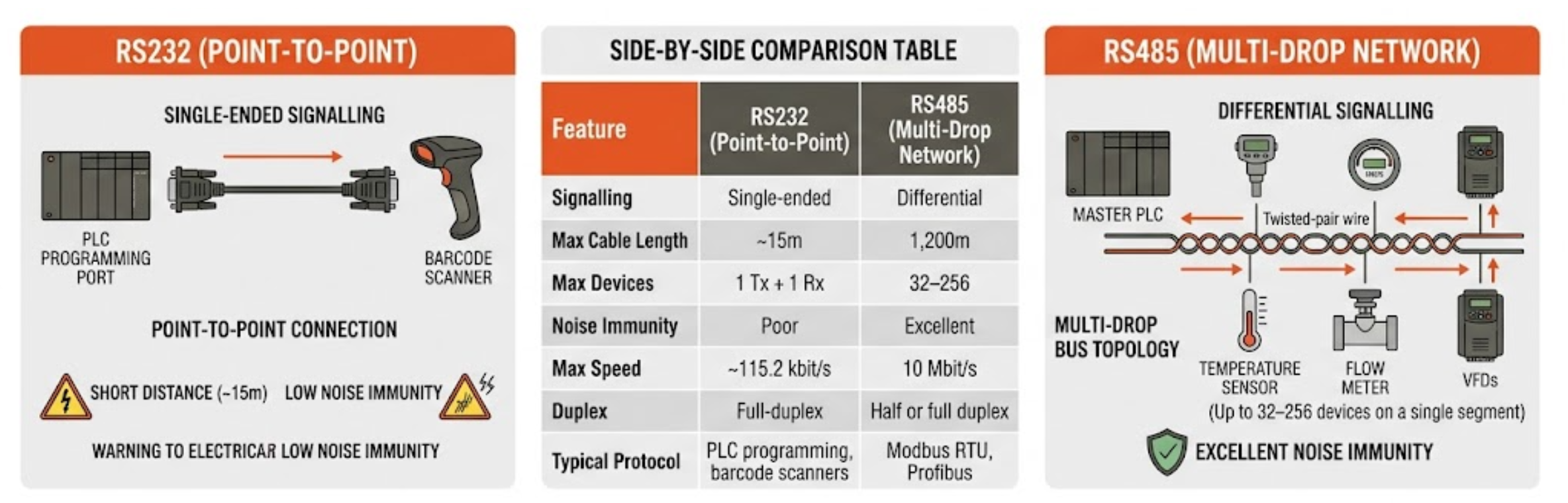
In the world of industrial automation, the RS485 vs RS232 choice shapes how your plant floor devices communicate for years. Both are legacy serial communication protocols — but they serve fundamentally different applications. RS232 is a point-to-point industrial serial interface suited for short-distance, one-to-one connections. RS485 is a differential, multi-drop network serial communication protocol designed for long-distance, multi-device industrial environments. Understanding the RS485 vs RS232 trade-offs in distance, noise immunity, topology, and cost determines which industrial serial interface is right for your application.
RS232: The Point-to-Point Serial Communication Protocol
RS232 (officially EIA-232) is the original PC-era serial communication protocol, standardised in 1969. It uses single-ended signalling — voltage levels between +3V to +15V (logic 0) and -3V to -15V (logic 1) referenced to a common ground. This RS232 point-to-point industrial serial interface design means only two devices can communicate per port — one transmitter and one receiver. The practical RS232 cable length limit is approximately 15 metres at 9,600 baud, though higher speeds reduce this further. RS232 is inherently susceptible to electrical noise because single-ended signals do not reject common-mode interference — the very noise that pervades industrial environments with variable-frequency drives, motors, and switching power supplies.
Despite these limitations, RS232 remains in widespread use as an industrial serial interface for programming ports on PLCs and drives, connecting barcode scanners and weighing scales, and linking SCADA workstations to nearby measurement instruments. For these RS232 point-to-point applications, its simplicity and universal availability make it the path of least resistance.
RS485: The Multi-Drop Industrial Serial Interface
RS485 (EIA-485) addresses every major limitation of RS232. It uses balanced differential signalling — the voltage difference between two wires (A and B) carries the signal, not the absolute voltage level. This differential approach gives RS485 exceptional noise immunity: electromagnetic interference affects both wires equally, and the differential receiver cancels out the common-mode noise. RS485 vs RS232 noise immunity is the single most important factor for plant floor deployments where EMI is unavoidable.
The RS485 multi-drop network topology allows up to 32 standard devices (up to 256 with low-load transceivers) to share a single twisted-pair bus run extending up to 1,200 metres. This RS485 multi-drop capability is what makes it the universal industrial serial interface for Modbus RTU, Profibus, and DMX networks. RS485 half-duplex operation on two wires (or full-duplex on four wires) suits the master-slave communication patterns that dominate industrial serial interface deployments.
RS485 vs RS232: Side-by-Side Comparison
| Feature | RS232 (Point to Point) | RS485 (Multi-Drop Network) |
|---|---|---|
| Signalling | Single-ended | Differential |
| Max Cable Length | ~15 m at 9,600 baud | 1,200 m at 100 kbit/s |
| Max Devices | 1 transmitter + 1 receiver | 32–256 per segment |
| Noise Immunity | Poor (single-ended) | Excellent (differential) |
| Max Speed | 115.2 kbit/s (typical) | 10 Mbit/s (short distances) |
| Duplex | Full-duplex (separate TX/RX) | Half or full duplex |
| Typical Industrial Protocol | Point-to-point Modbus, PLC programming | Modbus RTU, Profibus, RS485 multi-drop Modbus |
| Connector | DB9 / DB25 | Terminal block or DB9 |
Choosing Between RS485 vs RS232 for Your Industrial Serial Interface
In the RS485 vs RS232 decision, the application requirements define the answer:
- Choose RS232 point to point when: You are connecting a single device — a barcode scanner, GPS module, or PLC programming port — to a host over a short distance in a low-noise environment. RS232 point-to-point industrial serial interface connections are simple, require no bus termination, and work with standard DB9 connectors.
- Choose RS485 multi-drop when: You need to connect multiple sensors, meters, or PLCs on a shared bus over distances beyond 15 metres in an electrically noisy industrial environment. RS485 multi-drop networks running Modbus RTU are the backbone serial communication protocol for most industrial automation systems globally.
- Convert RS232 to RS485 when: You have existing RS232 point-to-point devices that need to join an RS485 multi-drop network. An RS232-to-RS485 converter handles the signal-level translation transparently, preserving the existing serial communication protocol without hardware changes.
Connect RS485 and RS232 Devices to the IIoT with Precisol
Whether your plant runs RS485 multi-drop Modbus networks or legacy RS232 point-to-point connections, Precisol Automation has the industrial serial interface hardware to bring that data into the modern IIoT ecosystem. The RS485 Serial IIoT Edge Gateway connects RS485 multi-drop networks to cloud platforms, aggregating Modbus RTU data and publishing it via MQTT with local edge analytics. For RS232 point-to-point devices at remote sites, the RS232 Serial to Cellular Gateway provides 4G LTE connectivity directly from the RS232 port.
See RS485 industrial serial interface connectivity at work in our industrial boiler monitoring case study, or explore how Precisol enables remote analog input monitoring over RS485 and RS232 serial communication protocols.
Frequently Asked Questions
What is the key difference between RS485 vs RS232?
RS485 vs RS232 differs in topology and noise immunity. RS232 is a point-to-point serial communication protocol limited to 15 metres and one device. RS485 uses differential signalling on a multi-drop network supporting 32–256 nodes over 1,200 metres with excellent noise immunity — the preferred industrial serial interface for plant floor deployments.
Can I convert RS232 to RS485 on existing equipment?
Yes. An RS232-to-RS485 converter module translates between the two serial communication protocols transparently, allowing RS232 point-to-point devices to join an RS485 multi-drop network without firmware changes — extending the industrial serial interface lifespan of existing equipment.
How many devices can connect on an RS485 multi-drop network?
Standard RS485 supports 32 unit loads per segment. With low-load transceivers, RS485 multi-drop networks support up to 256 nodes. RS485 repeaters extend the bus further. This far exceeds what any RS232 point-to-point industrial serial interface can achieve.