SOME/IP Protocol: Service-Oriented Communication in Modern Vehicle Networks
13 October 2026
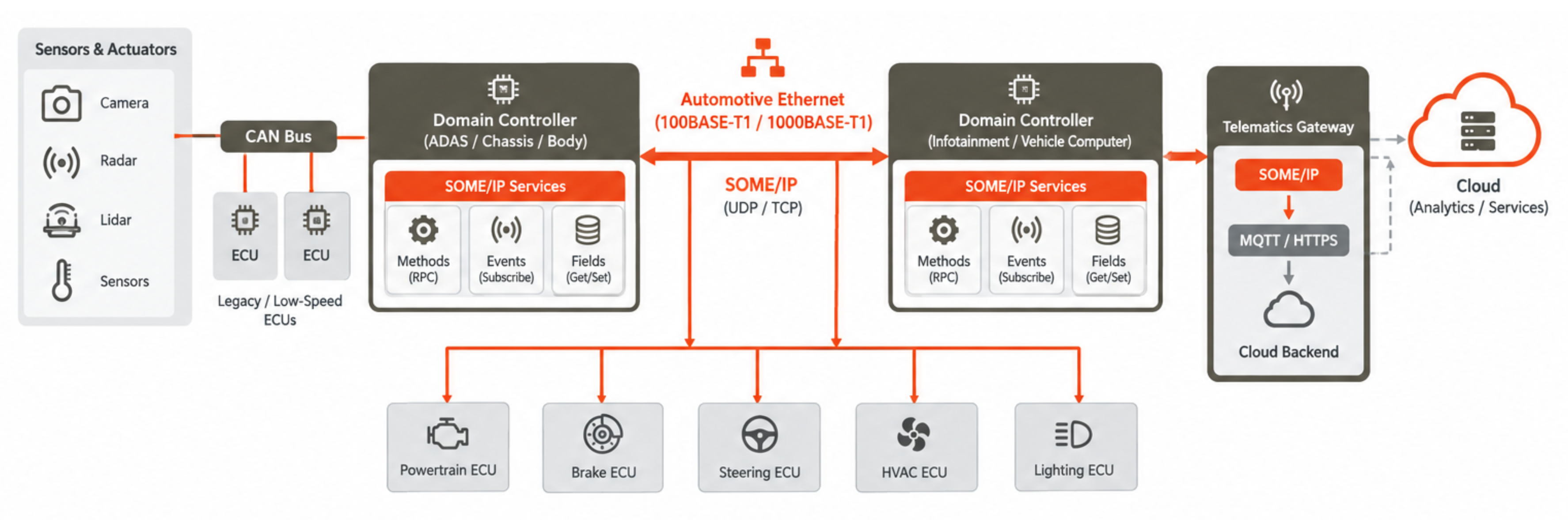
SOME/IP protocol automotive is the middleware standard that enables the shift from CAN bus's signal-based communication model to the service-oriented vehicle communication architecture that modern software-defined vehicles require. As vehicle electronics move from dozens of simple ECUs exchanging small signals over CAN bus to centralised compute platforms running complex software stacks over Automotive Ethernet, the communication paradigm must change fundamentally: instead of broadcasting fixed signals on a shared bus (CAN's model), ECUs now expose services — callable functions, subscribable events, and readable/writable fields — that other ECUs discover and consume over an IP network. SOME/IP protocol automotive (Scalable service-Oriented MiddlewarE over IP), standardised under AUTOSAR SOME/IP, is the industry's answer to this requirement. It defines how services are discovered (SOME/IP Service Discovery), how they are called (method invocation over UDP/TCP), and how event subscribers receive updates (event notification) — all over the SOME/IP Ethernet automotive network backbone built on 100BASE-T1 or 1000BASE-T1 physical links. Understanding SOME/IP protocol automotive is now essential for automotive software engineers, ECU developers, and test engineers working on any vehicle programme that uses Adaptive AUTOSAR, ADAS domain controllers, or connected vehicle architectures. The SOME/IP vs MQTT automotive question also arises frequently as teams design the boundary between in-vehicle service-oriented communication and vehicle-to-cloud data publishing — the answer is that they are complementary, not competing, protocols.
SOME/IP Protocol Automotive: Core Concepts
- Service Discovery (SOME/IP-SD): Before service-oriented vehicle communication can begin, ECUs must find each other's services. SOME/IP Service Discovery (SOME/IP-SD) enables provider ECUs to offer their services on the network and consumer ECUs to find them — without hardcoded IP addresses or configuration files for every possible ECU pair. SOME/IP-SD broadcasts service offer and find messages over multicast UDP, enabling dynamic discovery as ECUs boot in any order. This is a fundamental shift from CAN bus, where the communication matrix is fully defined at design time and fixed.
- Methods, Events, and Fields: SOME/IP protocol automotive defines three communication patterns that together cover the full range of service-oriented vehicle communication needs: Methods (request/response RPC — consumer calls a function on the provider and awaits a response, e.g., request navigation route calculation); Events (one-to-many notification — provider pushes data to all subscribed consumers when a value changes, e.g., vehicle speed update to all consuming ECUs); and Fields (getter/setter/notifier combination — a value that can be read, written, or subscribed to, e.g., climate set-point). AUTOSAR SOME/IP defines the serialisation of all three patterns into binary UDP or TCP payloads.
- SOME/IP Ethernet Automotive — Network Transport: SOME/IP Ethernet automotive runs over standard IP — UDP for time-critical events and low-latency method calls; TCP for reliable large-payload data transfers and OTA-related method invocations. The underlying physical SOME/IP Ethernet automotive network uses 100BASE-T1 or 1000BASE-T1 Automotive Ethernet physical links. VLAN tagging (802.1Q) and QoS mechanisms separate SOME/IP traffic from other Ethernet traffic on the same physical infrastructure.
- SOME/IP vs MQTT Automotive — Complementary Roles: In connected vehicle architectures, SOME/IP vs MQTT automotive is resolved by architectural separation: SOME/IP protocol automotive for intra-vehicle ECU-to-ECU and ECU-to-domain-controller service calls; MQTT (or REST/HTTPS) for telematics data published from the vehicle's connectivity gateway to cloud backends. A telematics ECU subscribes to SOME/IP protocol automotive service events (vehicle speed, fuel level, fault codes) and republishes selected data to the cloud via MQTT — combining the richness of service-oriented vehicle communication inside the vehicle with the lightweight efficiency of MQTT for cloud transport.
SOME/IP Protocol Automotive: Communication Patterns Compared
| Pattern | SOME/IP Protocol Automotive Mechanism | Equivalent in CAN Bus |
|---|---|---|
| Method (RPC) | Request/response over UDP or TCP; service-oriented vehicle communication | No equivalent — CAN has no request/response mechanism |
| Event | SOME/IP-SD subscription; provider pushes to all subscribers | Periodic or event-driven CAN frame broadcast on bus |
| Field | Getter/setter method + event notification — AUTOSAR SOME/IP field | Combination of read signal + write signal (separate frames) |
| Discovery | SOME/IP-SD dynamic multicast announce/find | None — CAN IDs are statically defined in the communication matrix |
| Transport | SOME/IP Ethernet automotive over 100BASE-T1 / 1000BASE-T1 | CAN bus 2-wire, 125 kbit/s – 8 Mbit/s |
SOME/IP Protocol Automotive Testing with Precisol Automation
Testing SOME/IP protocol automotive networks requires capturing both the Ethernet frames and the SOME/IP payload layer — validating service discovery sequences, method call round-trip times, and event notification delivery to all subscribers. Precisol Automation's CAN Bus Gateway bridges between the CAN bus domains and the SOME/IP Ethernet automotive backbone — the same gateway function tested in service-oriented vehicle communication integration test campaigns. The CAN Data Logger captures the CAN side of mixed-protocol SOME/IP vs MQTT automotive boundary testing — validating signal-to-service translations at the gateway.
See mixed-protocol embedded network data acquisition in our autonomous mobile robot testing case study, or explore AMR field testing with CAN bus gateway for CAN-to-IP bridging validation approaches relevant to AUTOSAR SOME/IP gateway integration testing.
Frequently Asked Questions
What is SOME/IP protocol and what is it used for in automotive networks?
SOME/IP protocol automotive is a service-oriented middleware standardised under AUTOSAR SOME/IP that enables service-oriented vehicle communication over Automotive Ethernet. Provider ECUs expose services (methods, events, fields); consumer ECUs discover them via SOME/IP Service Discovery and subscribe to events or call methods over UDP/TCP. It replaces CAN bus signal broadcasting with dynamic, scalable service-oriented vehicle communication for ADAS, infotainment, and connected vehicle applications.
What is the difference between SOME/IP vs MQTT for automotive IoT communication?
SOME/IP vs MQTT automotive: SOME/IP protocol automotive handles intra-vehicle service-oriented vehicle communication between ECUs over SOME/IP Ethernet automotive — rich service discovery, RPC methods, event subscription, binary serialisation. MQTT handles vehicle-to-cloud data transport — lightweight pub-sub, 2-byte header, broker-based, universal cloud IoT platform support. Modern connected vehicles use SOME/IP inside the vehicle and MQTT from the telematics gateway to the cloud: complementary, not competing protocols.
How does AUTOSAR SOME/IP relate to Adaptive AUTOSAR?
AUTOSAR SOME/IP is the primary communication middleware in Adaptive AUTOSAR — the high-performance compute platform standard for Linux/QNX-based ECUs running ADAS, infotainment, and V2X applications. Adaptive AUTOSAR applications expose ara::com service interfaces implemented using SOME/IP protocol automotive as the wire protocol over SOME/IP Ethernet automotive links. AUTOSAR SOME/IP in Classic AUTOSAR enables traditional ECUs to interoperate with Adaptive AUTOSAR ECUs via gateway translation between CAN signals and SOME/IP service events.