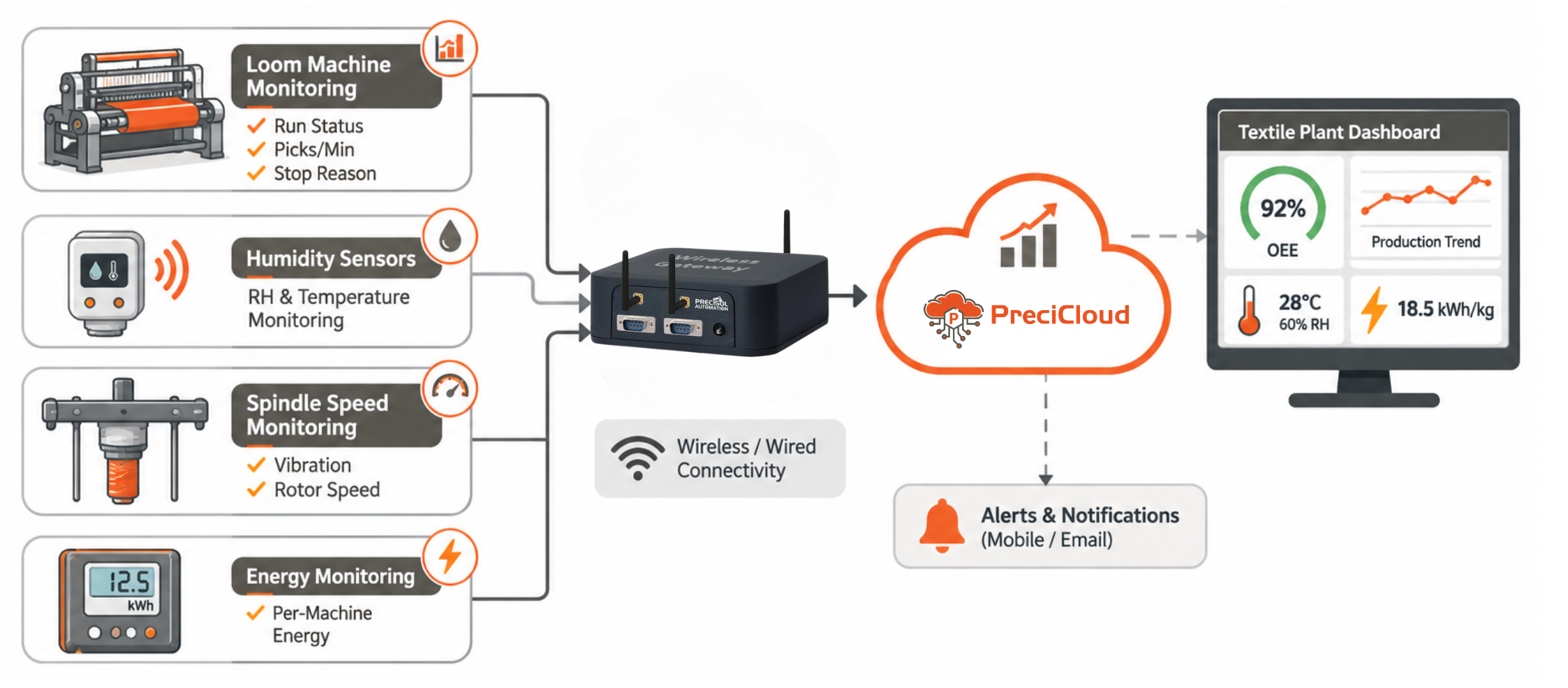
Textile manufacturing IoT monitoring addresses an industry where hundreds of machines run simultaneously in large production halls, where subtle process parameter deviations (a 3% humidity drop, a single loom running 5% below optimal picks per minute, three ring spindles with worn whirl bearings) accumulate silently into significant quality losses and production shortfalls that are only discovered at fabric inspection — hours or days after the problem began. Traditional textile plant management relies on roving supervisors manually checking loom stop indicators, periodic humidity readings from handheld instruments, and end-of-shift production counts from manual logging — a system that cannot provide real-time visibility across 200–500 looms running concurrently and cannot detect the gradual process drift that causes quality problems before they reach critical levels. Loom machine monitoring IoT systems wirelessly connected to each loom provide real-time OEE (Overall Equipment Effectiveness) per machine, stop reason analysis, and shift production tracking — transforming supervisor rounds from reactive fault-finding into proactive exception management. Textile humidity temperature control IoT networks with sensors across the entire production hall provide continuous environmental monitoring with automated HVAC alerts before conditions drift outside the narrow optimal range for each yarn type. Spindle speed monitoring IoT identifies under-performing spindles and frames producing off-specification yarn before quality problems escape to the fabric inspection stage. And textile plant energy monitoring across looms, ring frames, HVAC, and compressed air systems provides the energy consumption visibility needed for ISO 50001 compliance and cost reduction programmes in an industry where energy represents 15–25% of manufacturing cost. This guide covers the practical textile manufacturing IoT monitoring implementations for each of these areas, with sensor technologies, communication approaches, and ROI benchmarks from textile plant deployments.
Textile Manufacturing IoT Monitoring: Key Application Areas
- Loom Machine Monitoring IoT — OEE and Stop Analysis: Loom machine monitoring IoT systems attach to existing looms via current transformers (motor run detection), digital inputs to stop relay signals (warp break, weft break, end of cloth), and pulse counter inputs for pick count. A wireless IIoT node per loom, or a wired gateway per loom bank, transmits data to a textile manufacturing IoT monitoring platform providing: real-time loom status board (running/stopped per loom, visible on shop floor display); stop reason breakdown by category per shift; picks per minute trend to detect gradual speed loss; and shift production vs. target. Loom machine monitoring IoT platforms with mobile alerts notify the relevant operator when a loom stops, tracking response time and enabling accountability for restart delays that reduce efficiency.
- Textile Humidity Temperature Control — Environmental IoT: Textile humidity temperature control IoT networks use capacitive humidity and temperature sensors (±2% RH, ±0.5°C accuracy) at 5–10 m intervals across spinning halls, weaving sheds, and processing areas — transmitting readings every 30 seconds to the building management system and simultaneously to the textile manufacturing IoT monitoring cloud platform. Zonal humidity mapping identifies hot/dry spots near doors, skylights, or air conditioning vents where yarn conditions drift outside specification. Alerts at ±3% RH from setpoint notify HVAC operators before yarn break rates increase. Historical humidity correlation with yarn break data and quality inspection results builds the evidence base for optimising seasonal humidification setpoints.
- Spindle Speed Monitoring IoT — Ring Frame Condition: Spindle speed monitoring IoT for ring spinning identifies individual spindle and whole-frame performance deviations. Vibration sensors on ring frame spindle rails detect the high-frequency signature of spinning spindle whirl wear (typically 0.5–3 kHz) that precedes belt slip and yarn quality degradation. Frame motor current trending detects aggregate spindle load reduction from widespread belt wear before supervisor inspection would catch it. Textile manufacturing IoT monitoring platforms display frame-by-frame spindle performance indices, flagging frames requiring maintenance and correlating spindle anomaly scores with yarn quality imperfection counts from online yarn clearers.
- Textile Plant Energy Monitoring — Cost and ISO 50001: Textile plant energy monitoring IoT deploys energy meters (RS485 Modbus) on loom drive distribution panels, ring frame motor feeders, compressed air systems, and HVAC units — providing per-machine and per-department energy consumption data that bulk utility metering cannot resolve. Shift energy per kilogram of yarn produced tracks efficiency trends and benchmarks against best practices. Textile plant energy monitoring data integrated with production counts from loom machine monitoring IoT automatically calculates energy intensity KPIs for ISO 50001 energy management system requirements.
Textile Manufacturing IoT Monitoring: Key Parameters
| Application | Textile Manufacturing IoT Monitoring Parameter | Typical Benefit |
|---|---|---|
| Loom Machine Monitoring IoT | Run status, picks/min, stop reason, cloth length | 10–20% OEE improvement; stop response time reduction |
| Textile Humidity Temperature Control | RH ±2%, temperature ±0.5°C — zone mapping | 20–40% yarn break reduction; quality consistency |
| Spindle Speed Monitoring IoT | Spindle vibration, frame motor current, rotor speed | Defective spindle identification before quality escape |
| Textile Plant Energy Monitoring | Per-machine kWh via Modbus energy meter | 15–25% energy intensity reduction; ISO 50001 data |
Textile Manufacturing IoT Monitoring with Precisol Automation
Precisol Automation's Wireless Humidity Sensor provides the textile humidity temperature control IoT network for spinning and weaving hall environmental monitoring — battery-powered, wireless mesh, with live humidity and temperature readings to cloud dashboards. The PreciCloud IoT Cloud Dashboard provides the unified textile manufacturing IoT monitoring platform for loom status, environmental conditions, and energy consumption — with mobile alerts and shift production reporting.
See environmental and energy monitoring in our warehouse temperature monitoring case study, or explore remote temperature monitoring for industrial process for the textile humidity temperature control IoT deployment pattern applicable to spinning and weaving environments.
Frequently Asked Questions
How does IoT monitoring improve loom machine efficiency in textile plants?
Loom machine monitoring IoT connects to each loom's motor current, stop relays (warp break, weft break), and pick counter to provide real-time OEE per machine, stop reason analysis, and shift production tracking. Textile manufacturing IoT monitoring platforms display loom status boards, track operator stop response time, and provide shift accountability reporting. Plants typically achieve 10–20% loom efficiency improvement through faster stop response, targeted maintenance, and data-driven shift management with loom machine monitoring IoT.
Why is humidity and temperature control critical in textile manufacturing?
Textile humidity temperature control is critical because yarn properties (strength, elongation, static charge) depend on ambient conditions. Cotton needs 65–70% RH — below 60% causes brittleness and increased yarn breaks (20–40% more breaks with 5% RH drop). Textile manufacturing IoT monitoring sensors at 5–10 m intervals across the production hall provide continuous zone mapping with alerts at ±3% RH from setpoint, enabling HVAC correction before yarn break rates rise and quality inspection failures accumulate.
How is spindle speed monitoring used for IoT in textile spinning plants?
Spindle speed monitoring IoT detects under-performing ring spindles via vibration sensors on spindle rails (identifying whirl wear signature at 0.5–3 kHz) and frame motor current monitoring (reduced load indicating belt slip). OE rotor speed sensors detect bearing degradation in individual rotor units. Textile manufacturing IoT monitoring platforms correlate spindle anomaly scores with yarn quality imperfection counts from online clearers — identifying frames and spindles producing off-spec yarn before defects reach fabric inspection or customer returns.